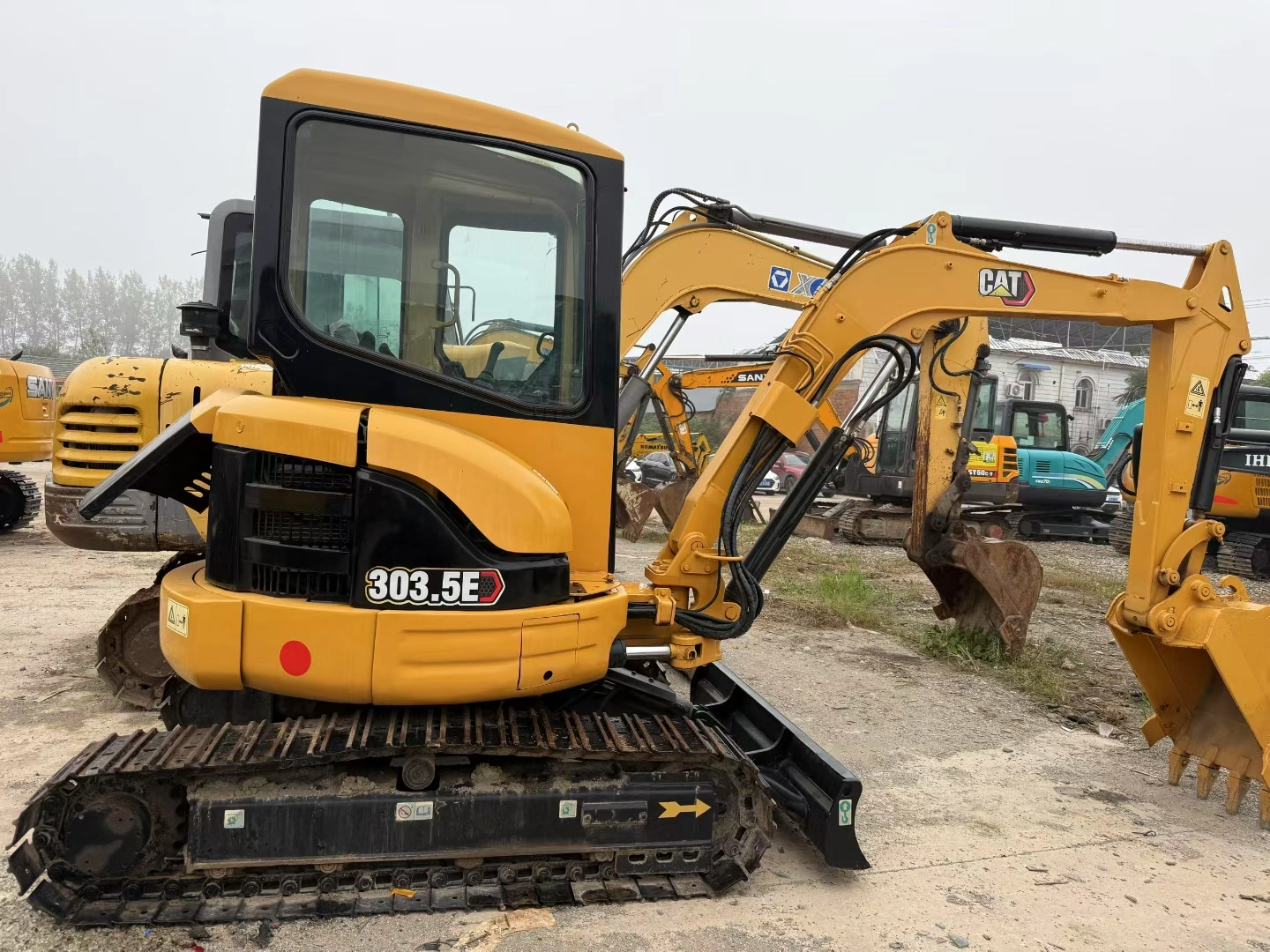

CAT Mini Excavator Swing System Design Evolution 303.5E vs. 305.5E2 Durability
With the bucket over the tracks, the swing bearing is subjected to a load vector almost passing straight through the center of the swing bearing. Then, as soon as you pull the stick out to just about its max length, and start filling the bucket up with wet clay or broken concrete, the weight moves over to an outboard position. Thus, the entire upper structure is now seeking to tip and the swing bearing must withstand the tipping force, in addition to providing for smooth rotation. With each ball under load, it is elastically compressed — on the order of micrometers — but still compressed nonetheless. For an asymmetric load case, 3-4 balls will be left to carry 60% of the moment load.
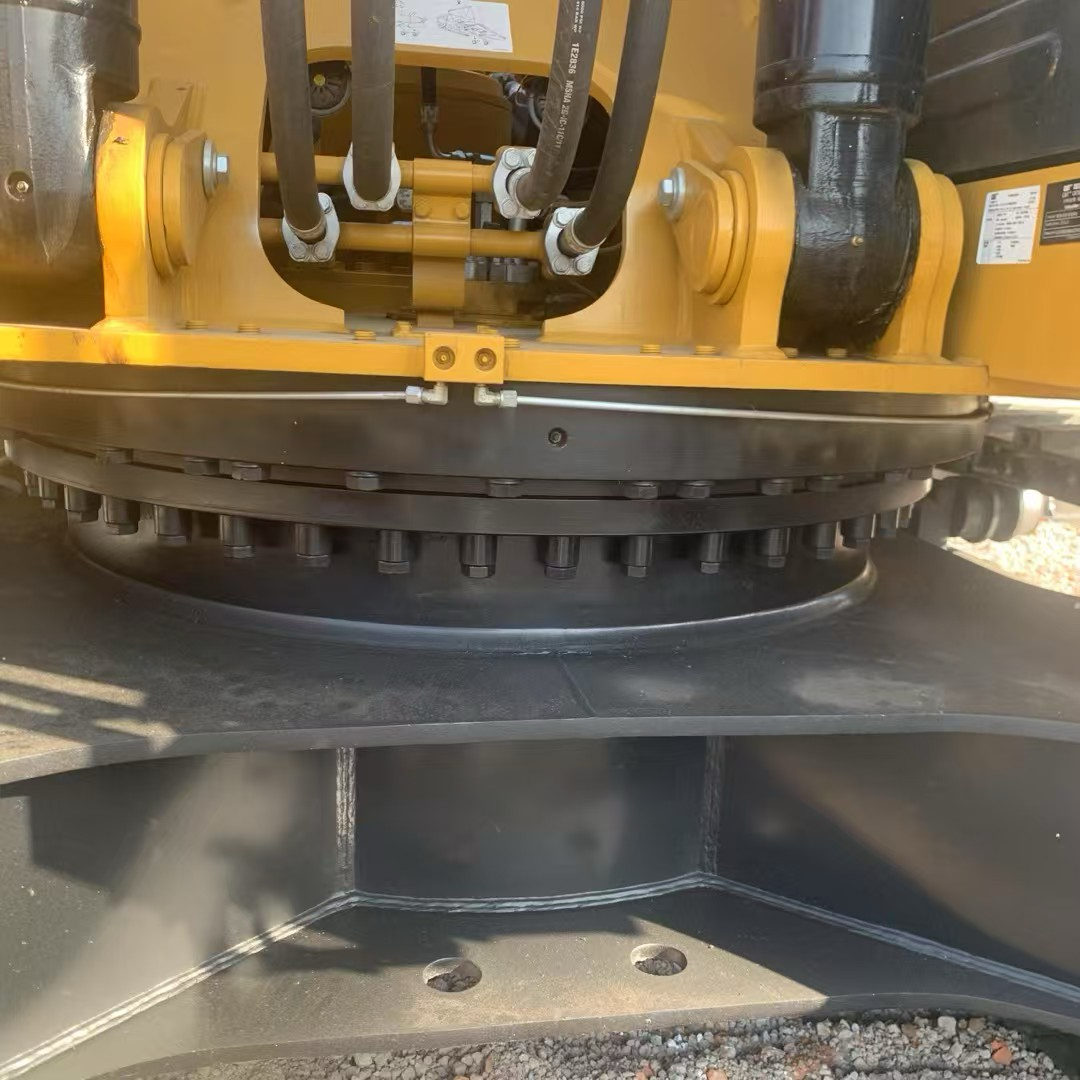
This deceleration shock is two to three times greater than the steady state load, and is sent through the bearing. This equates to 560 shock events in an hour-and-a-half. When expanded over a six-day rental lease, that means that 24 balls in one row must handle more than 40 000 impact cycles each month.
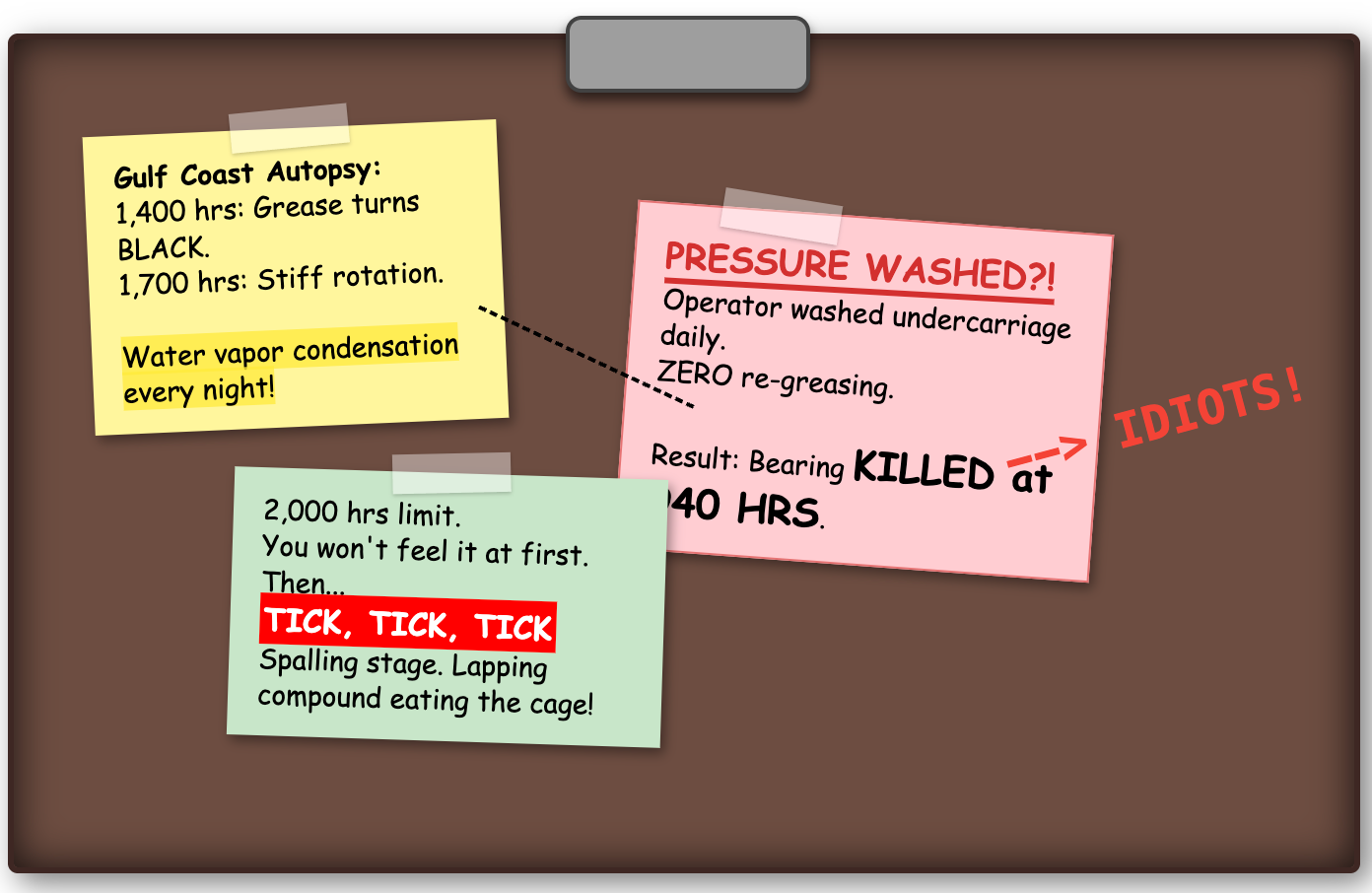
Surface fatigue is the first stage, when the hardened race wearing surface develops micro cracks which grow under the action of cyclic loading. You won’t hear it. You won’t feel it. It’s just that the colour of the grease will be a bit darker. Then, at stage two (spalling), you will hear a rhythmic tick, tick, tick in rotation, and chunks of hard particles are beginning to float in the grease around the race. With these flakes, it’s kind of like lapping compound, which makes for a lot of additional wearing on the balls and cage.
One row no longer needs to support three loads – radial, axial and moment – as there are now two rows in a coupled arrangement which support these loads. When the bucket is loaded while it is extended the outer row is responsible for taking the majority of the radial load. The deceleration inertia when you hit hard on the swing brake is attempting to pull the “races” off of one another, while the dual row attempts to counteract this by putting both races in tension and compression.
Peak swing deceleration spikes were seen on the 303.5E, when this machine was run at full swing speed and the operator attempted to reverse direction. The lower the peak stress on a ball is, the longer the fatigue life of the ball.
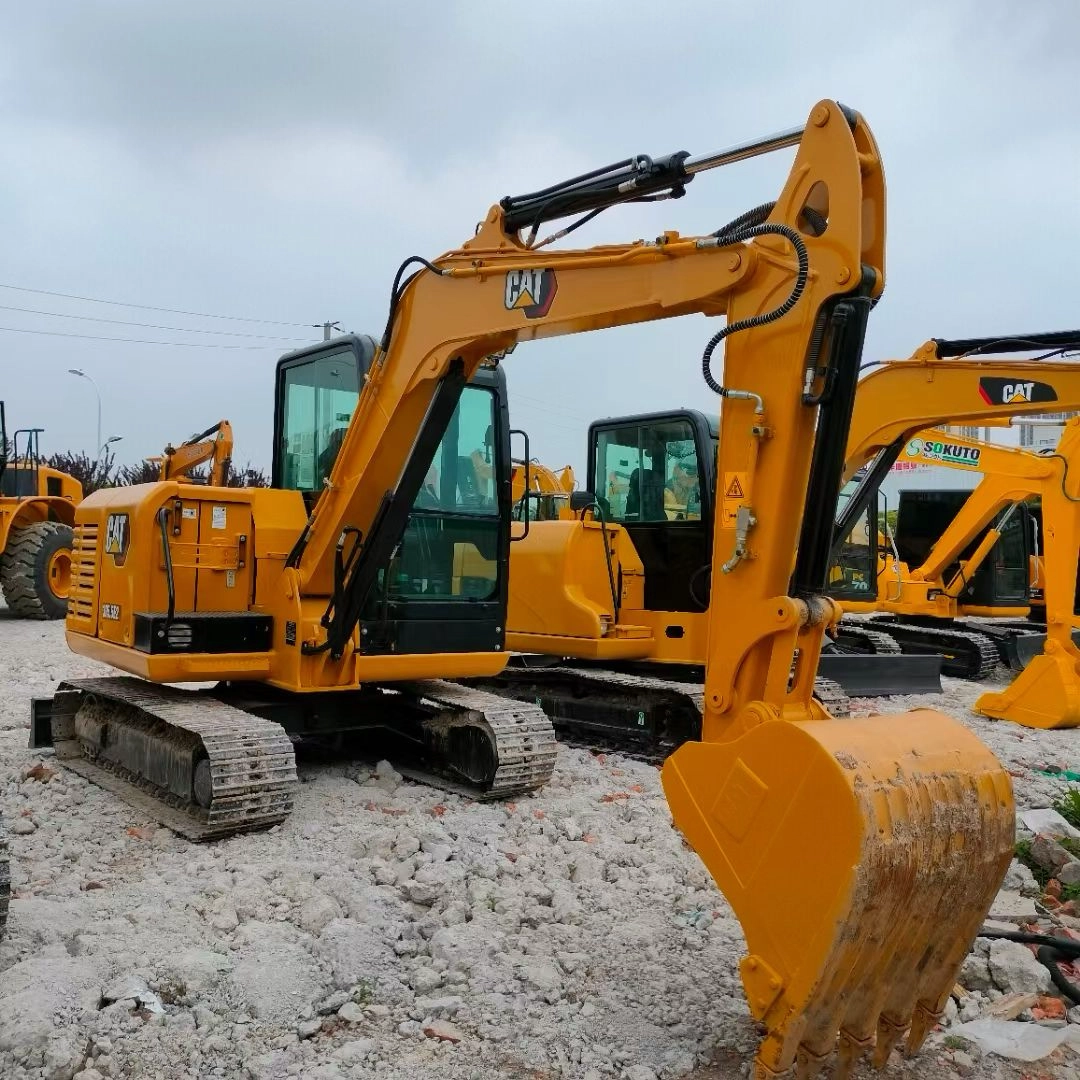
However, what Caterpillar doesn’t tell you in the brochure is the 305.5E2 has a dual row bearing, which is heavier, and needs more pre-load when installing in order to work properly. It’s not the part. It’s the installation.
The operator had been pressure washing the undercarriage every day but had not considered re-greasing the undercarriage following pressure washing. This bearing ran for 940 hours.
Data sources for the table above:Swing Bearing Death Timeline
I have monitored the 303.5E units that I have in the Gulf Coast region and have found swing bearing distress at about 1,650-2,100 hours in the rented units. Symptoms occur in a consistent order of grease darkening at 1,400 hrs, light increase of swing resistance at 1,700 hrs and then the swing resistance is so great there is an audible tick at 2,000 hrs.
Water vapor is deposited inside the bearing cavity each time there is a night cool down in the Gulf. That moisture picks up the grease and compounds the effect of corrosion occurring on the race surface. The dust is corrosive but at a lower rate than the rust pitting.
The first symptoms I’ve seen on the 305.5E2’s that I have tracked occurred between 3,100 hours and 3,800 hours in the same geographic region in the Gulf Coast. This is an 80-90% improvement of service interval on the 303.5E. Here in the Southwest I still have two 305.5E2 machines, that are still in good health after over 4,500 hours, without any problems with swing bearings.