
How to Physically Test Swing Bearing Condition Without Disassembly
New operators assume this all the time – if it moves it’s OK. That’s probably the single biggest outlay in the compact excavator market, combined with track wear and hydraulic leaks. You need to have three particular test protocols, which are non invasive, so you can tell what’s going on inside that closed chamber without removing a bolt.
Why This Failure Category is statistically invisible–until it is ‘too late’.
The geometry of the swing bearing installation means that it is difficult to detect problems in time unless you’re aware of some measurements to take. Think of the bearing as the ring (typically 30″ to 40″ in diameter) of a machine, 3-6 tons in weight, that is bolted to the undercarriage turntable and has an inner race bolted to the upper structure of the machine. Those two races are separated by the ball bearings in the form of hardened steel balls which run in the machined grooves.
All that grease begins to decompose. When the lubricating oil film properties decrease, there is metal-on-metal contact between the balls and the races. This contact results in tiny pits being formed on the race surfaces (spalling). In each pit tiny metal particles are formed which become suspended in the grease. At this point abrasive contamination is in the bearing, and the action of the spalling is accelerated. It’s a cascade.
Radial Play Measurement Using Dial Indicators (The Only Number That Matters)
I have seen people put a pry bar under the boom and eye it, and say that it’s good. All that indicates is you don’t know much. You must have the dial indicator, it must be firmly secured and the machine must be configured so that only the bearing movement acts on the dial indicator.
The boom should be perpendicular to the centre of the track – at right angles to the undercarriage. Why? When you put lateral force in the boom tip it forms an arm which will attempt to bend the whole top over. So all you get is the measurement of frame flex and not the measurement of bearing play! I just use a digital inclinometer which is magnetically attached to the side of the boom. Takes thirty seconds. Helps you get close to the “True 90”.
People mess up here, by only taking one measurement. There should be 3 measurement points around the circumference of the swing ring. This will provide you with a 3-dimensional picture of the wear on the bearing. By only measuring at one point you may get a good measurement of a section of the bearing out of shape, while 120 degrees away the races are hammered.
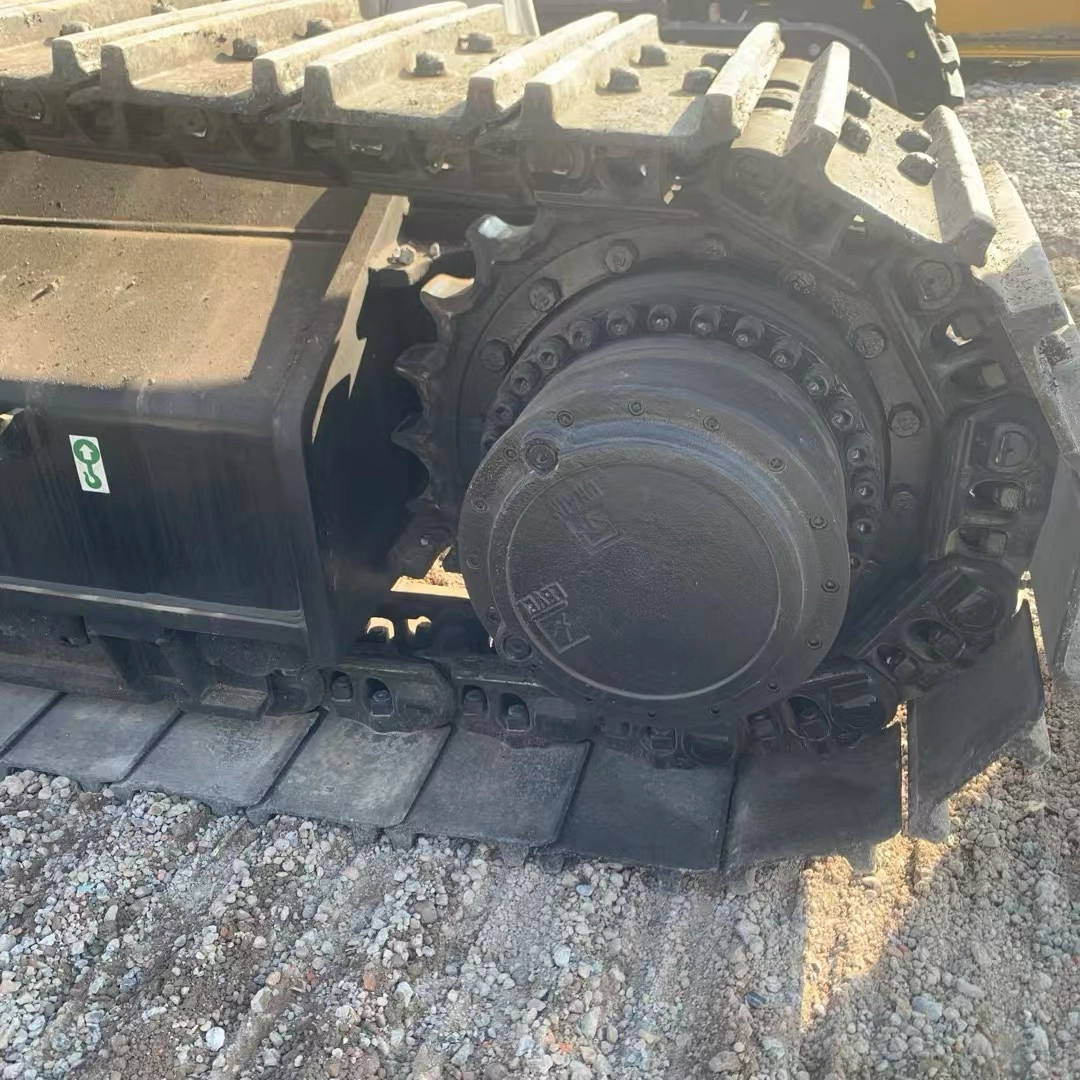
The indicators I use are Mitutoyo or Starrett. They cost $120. It’s been 11 years and I am still using the same 2 gauges.
It’s not simply wiggling the boom. A constant lateral push (force) needs to be applied to the boom tip sufficient to produce a lateral push on the structure itself and pull out any slop in the bearing, but not so great that it begins to bend the boom. Pull, read the dial indicator needle, note down the reading, push in the opposite direction and note the reading. Radial play is the sum of all the sweeps.
Most of the 3-6 ton machines have a factory specification of a radial deflection of .004″-.008″ when the bearing is new.
What the Needle Movement Is Actually Telling You
Visualize what’s on the mechanical level. If some part of that groove spalls, say into a two millimetre wide pit half a millimetre deep, as the ball rolls past, for a fleeting moment the ball falls into this pit. That will be reflected in the needle, as a pause or a skip.
The first time I saw it I thought that my indicator was defective. We removed that bearing and there were no other spall craters found, just 7 pencil sized equidistant cuts around the bottom quadrant where the load was being applied.
Asymmetry on the other end is the other red flag. If 0.006″ is measured at 12 o’clock and 0.018″ is measured at 4 o’clock, then there is a loaded zone failure on the bearing. This is the left front quadrant – boom extended over the track and a full bucket being curled – for a typical excavator operator.
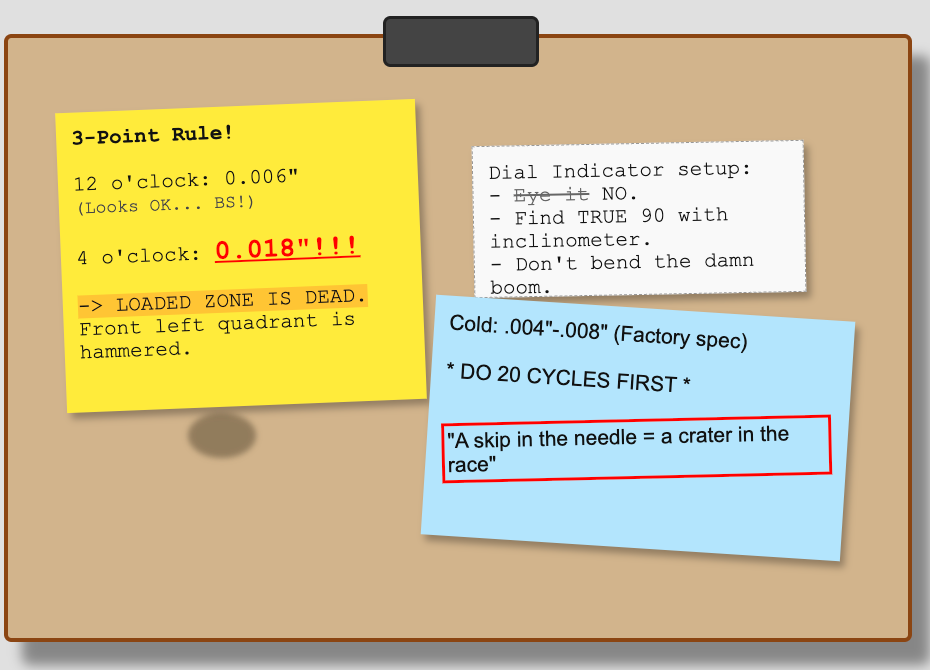
As swing bearings get hot they grow in size. First I make a cold measurement and then run the machine through a set of twenty normal swing cycles and take another measurement as long as the bearing is still hot.
Acoustic Signature Analysis (What Your Ears Know Before the Gauges Do)
When a swing bearing begins to fail you have a secondary acoustic signature, on top of that hydraulic signature. It’s just a sort of steady ticking that is in synch with the rotation speed. If you rock the house to the left at perhaps 8 RPM and you hear seven different ticks in a full turn then you have 7 “impact points” on the outside of the race where the ball bearings are sliding in spall craters and back climbing out again. It’s not random.
Spalling noise is dependent upon the rotational speed of the bearing. The ticking is proportional to the rate of the swing, as the swing is slowed, the ticking is slowed.This 1:1 relationship is the sign of a mechanical and not a hydraulic source.
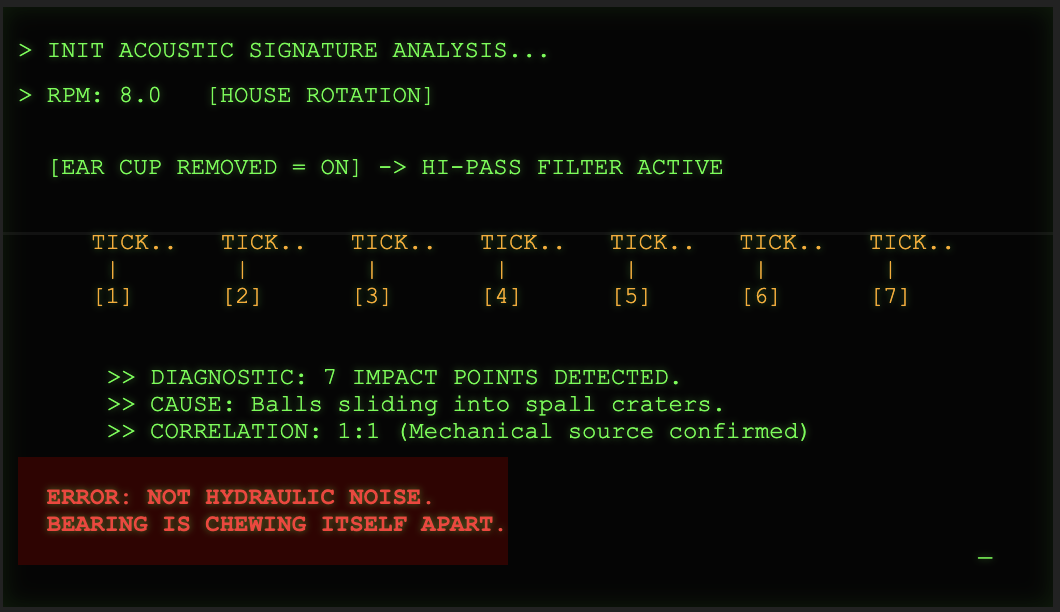
I also remove the ear cup on my hearing protection a millimetre from my left ear whilst the hearing test is on. This results in a natural high pass filter — the foam in the ear cup is effective in attenuation low frequency rumble (traffic, generators etcetera), while allowing higher frequency bearing tick to pass through. It’s an idiotic little trick that I learned from an old time millwright who had a line of work specializing in diagnosing gear box failures in paper mills.