
Buying a Used Kubota Mini Digger: How to Inspect Final Drive and Hydraulic Systems Before You Pay
Final Drive Inspection
Magnetic Drain Plug Inspection
Prior to all this, remove the magnetic drain plug from the final drive gearbox. I pulled a plug off of a KX161 one time when it was sold to me as having been serviced “two months ago” by the seller, and the magnet had such fine metallic flakes that the FURTHER side looked like it was covered with grey fur. Not big chunks. Fine ferrous particles. It’s a silent killer. If the pieces are big, it means that something broke quickly. Chronically grinding implies that there are fine particles every where.
Oil color matters:
Rejection threshold: when heavy case drain flow and a buildup of metallic debris, accompanied by colored gears are present. Pair up any 2 of those 3, I’m walking! All three? I don’t even have time to observe anything else, I’m gone.
Hydraulic System Inspection
Why Cold Pressure Tests Mislead You
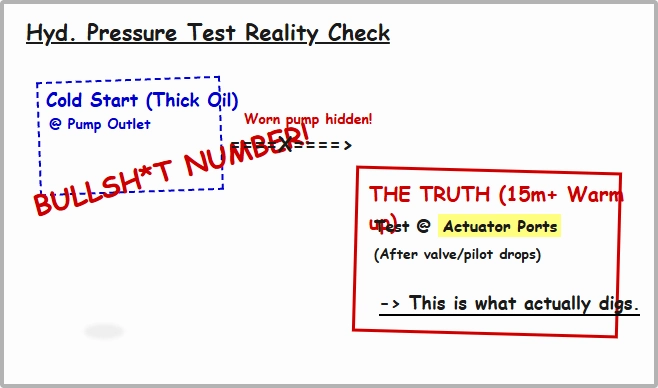
Hydraulic Oil is thick at cold start. The low ambient temperature viscosity is significantly greater than the operating temperature viscosity. A worn pump with moderate bypass can actually produce good pressure on a cold gauge just because the fluid has a high viscosity that is poor leakage fluid for worn clearances. You’ll get a number in range, you’ll feel as if you’ve done your homework well and you’ll be wrong.
Data sources for the table above:https://www.cat.com/en_US/articles/for-owners/get-to-know-your-cat-dozer-safety-features.html
Pressure Verification at Actuator Ports — Correct Test Sequence
This distinction matters. The pressure at the pump outlet is an indication of the pressure the pump is producing. Correct understanding of what is the actual pressure that reaches the working element after going through the control valve, pilot circuit, and direction valves is what is known as “Actuator port pressure.” It’s what is lost between those numbers that the story is in there.
Structural Inspection — Boom Root and X-Frame Junction
The two locations would have the highest stress concentrations on the machine. Those welds are under dynamic tension/load, but also compression/load every time the bucket strikes something hard, and the tension/load is passed back through the boom again, during every dig cycle. There are no indications of fatigue cracks here. They grow.
Dye Penetrant Testing
At this point it is important to note that while dye penetrant is an acceptable method, MPI is the only method for certain situations. For surface breaking cracks in non-porous weld metal, the aerosol cleaner, developer and dye in the dye penetrant testing method can be used. Apply penetrant, let stand for amount of time, remove excess penetrant, apply developer, inspect under strong light. It’s good for a weld showing a crack on the surface that you want to ascertain and quantify.
Preparing is the key for the problem in boom root inspections. That weld is usually extremely soiled with old paint, grease and fine soil that has been compressed in by vibration over the years, if it’s from a used machine. A dye test cannot properly be performed on metal if it’s contaminated. If there is compacted grit in the crack the penetrant is unable to work its way through the crack. The cracked weld will be clean.
Magnetic Particle Inspection (MPI)
Magnetic particle inspection — MPI — is not as dependent on the preparation of the part and can also identify subsurface discontinuities (ones which have not yet surfaced). By attracting ferrous particles, the magnetic field will promote the attraction of the particles to any discontinuity in the metal grain structure, such as the propagating fatigue crack, when it is still inside the metal piece.
Immediate Rejection (making both tests irrelevant): any repair weld, not made by the original manufacturer, on the boom root. The repair weld indicates that the crack has already occurred once. It informs you that the geometry to be used in repairing is not known. It means that the machine was under stress greater than it can handle that led to the fracture at a primary structural joint. Walk.
One test that can be performed without the use of equipment: take a look, raking light, in the boom root weld-line with eyes above – sunlight or a strong torch held at a low angle to the surface. Fatigue cracks that start to form under the surface can manifest in the paint as thin hair line cracks prior to the formation of cracks in the metal. First it is the paint that cracks. Not definitive per se, but, if you encounter it, you do MPI first.

Decision Framework — What to Do With What You Find
What to Negotiate vs. What to Walk Away From
One fault that makes a purchase unuseable, no matter how cheap it is: boom-root or X-frame cracking. Not a price adjustment – note that. Done.
The lost “combination” is failed case drain flow, confirmed hydraulic contamination and unknown service history. Any one of these may be handled separately. All three means that some internal condition is unknown on all of the primary systems at the same time. The probability problems when buying that item is bad, no matter what the asking price is.
<p>Prior to monies being exchanged obtain the following in writing:</p>
If the seller does not have this, assume that all the history of the machine is either unknown or bad, and inspect as such. Some of the machines don’t appear to be in any wreck or problem. These are the cars that seem “ok” on the surface: clean car, new paint, nothing wrong with them, only subtle issues slowly occurring/emerging at the same time.