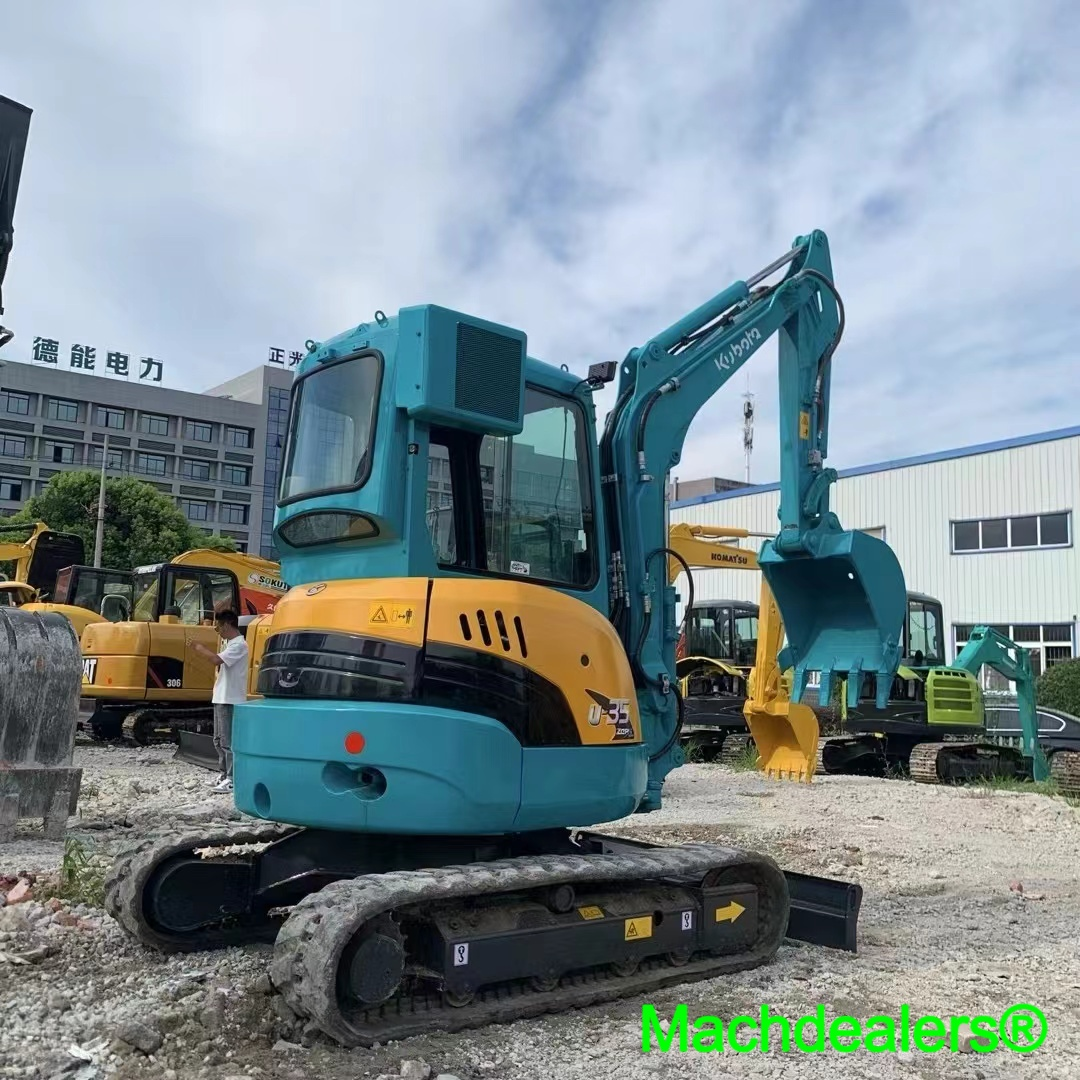

Importing a Used Kubota Mini Digger: Emissions Tier, Compliance, and Hidden Landing Costs
In reality, the Engine serial Number is used to reveal valuable information to the customs officials.
If a customs man or woman at a European customs house checks one of the imported second-hand Kubota mini excavators, one of the things he or she is least concerned with is the hour meter reading. The first verification they are doing is using the engine serial in comparison with the type-approval record.
Simple mechanical reasoning: That was followed by incremental internal revisions of Kubota’s engine families: the D902, D1105, and V2203 (in larger configurations). Depending on year of manufacture, the KX163-5 might have an EU IIIA, EU IV or EU V engine. Each engine serial number contains information about the batch of production the engine belongs to and each batch has a type-approval certificate with the relevant management body obtained from Kubota Corporation.
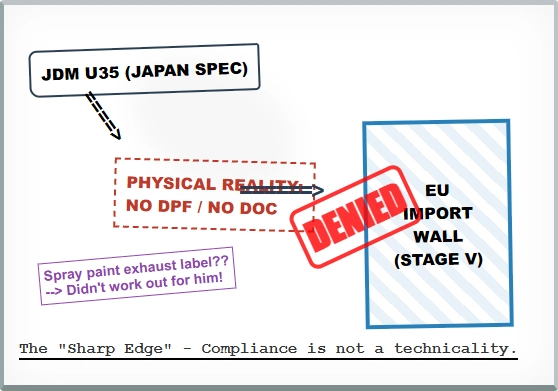
A harder one to crack is Japan domestic market. Machines designed for use in Japan were tested to the exhaust emission standard of Japan; which is rigorous, but not exactly as either a EU Stage or US EPA Tier standard. The starting words (serial prefixes) vary. Type-approval papers are in Japanese, include references to Japanese regulations and do not straight-forwardly convert to an EU Declaration of Conformity (DoC) or EPA Certificate of Conformity (CoC). When a Japanese-spec U35 is imported into the EU it is the responsibility of the importer to demonstrate compliance to EU Machinery Directive Requirements. Not the seller. Manufacturer is not the same one as specified on the facade. The importer.
Things get forensic in relation to the CE marking. The CE Mark on a machine which is manufactured for the EU is supported by a technical construction file and the Declaration of Conformity which states the responsible person for the machine, typically the person who manufactured the machine or the person who provides an EU Authorised Representative. There is a signatory, date and notified body (if third parties are necessary for the conformity assessment) to that document. Just as in the case of the used machine, when you purchase a used machine, you purchase that declaration’s declaration of origin. If this previous declaration was in relation to a notified body that is no longer named in this way then a re-issued declaration may be required before the machine will be cleared by the customs examiner.

So I drop down next to the engine bay and find the engine serial plate (not the boom serial plate, the engine serial that’s stamped on the block). I’m checking to see if the depth and oxidation pattern can be considered original factory marking. It can be determined with the fingernail. The bite-depth of a hydraulic press used to stamp a Kubota block is a specific stamp on the block. A subsequent re-stamp is usually shallower, or reveals tooling marks which are present in the surrounding metal but not present in the surface texture.
Nobody Prints — The Emissions Classification Table Tier by Year
Cut straight to it. KX163-5 models have entered the European market, making them type approved to EU Stage IIIA. Later production followed at Stage V and depending on the year of the production, succeeding batches reached stage IV. The U35 experienced a parallel, but not the same exact path, due to the engine configuration being at a “sharp edge” with some differences in the Tier boundary years applied. Here, this is significant at the border, but in a particular, mechanical, sense.
The EU Stage V particulate number limit (not necessarily the mass limit) at this power band of 19-56kW lead to a physical change in the engines after-treatment system. Machines not yet certified for Stage V do not necessarily have a diesel particulate filter, or if they have a DPF, it may be an old DPF that does not have the same capacity for regeneration cycles stated under Stage V, so it is not possible to retrofit to achieve compliance. Type-approval covers the engine’s production only, not parts that are bolted on after production.
The parallel market reference is EPA Tier 4 Final (for the US). DPF and in most cases diesel oxidation catalyst are also required for Tier 4 Final for this power band. Typically, these systems will not be part of a machine sold in Japan. It is physically impossible to bring its engine block and/or exhaust together to Tier 4 Final compliance in the field. Now, writing this suddenly reminds of the absurd case that the buyer-at-the-time sought to press, even to the EPA inspector that the exhaust housing being spray painted with a label was evidence of compliance for after-treatment. It didn’t work out for him!
Enter the grey area that snaps catch buyers. The machine can easily pass the Japanese export customs clearance — Japanese country does not block the export according to the emission standard of the country. That machine can also, export with clean documents of origin. The hard wall comes at the point of entry where the machine is to be imported; import approval is dependent on machine compliance with the standards in effect at the time of importation.
Narrow exceptions exist:
Data sources for the table above:https://www.kubotausa.com/gray-market-tractors
Any listing not specifically stating the machine’s emissions certification tier (not just the model year, but the tier itself) is lacking the most commercially-relevant information needed by a cross-border buyer. This is what new buyers believe is a “technicality.” Established purchasers recognize it’s the complete deal.
A 30 Year Buyer’s Pre-Purchase Checklist is written in his head. Not a framework. Not a methodology.
So here is what I DO check prior to giving anyone recommendation to wire a deposit.