

Don’t Trust the Hour Meter — How to Verify Hydraulic Condition and Instrument Readings on a Used Excavator
When I pulled the dipstick it was 7 in the morning on a class 20 ton machine, the fluid drained from the dipstick as light as it could have been just the last minute it was put in the pail. I still had half a sandwich left in my left hand wrapped in a napkin that I never opened and the merchant stood behind me talking about a full-service and a conscientious owner who operated it, but not to full capacity. 40 or so gallons of fresh fluid is not“nourishment.”Someone played out cash several hours prior to my arrival and people don’t do that for sentiment’s sake–they do it because the old fluid that was in that tank was telling a story that they did not want me to read.
If the color didn’t tell you, the smell did. The edge of things has a strong clean chemical (mineral) oil smell; the edge of the return line on an operational machine has a bit more oily and burned thing about it, sort of like the way a kitchen smells after you have burned something in a dry pan for too long. This one had an odor like that of a pail. When I placed the back of my hand on the return line it was warm but not hot, meaning it wasn’t much but it was also at idle; and when it comes to tired pumps, idle is the best spot to be.

At the inspection stage a recent oil change presentation is a negative and it takes the majority of buyers three machines and one poor pump experience to believe so. Sludge and varnish are in the cooler, in the lines, in the low spots in the tank–not what you see, a drain and refill moves the fluid that you can see around, but what’s in the corners of the tank and is in the lines and the cooler is the fluid that is shedding wear debris into the system every hour the machine operates–every hour you can see how clean it is. What is more difficult, is that the same thing happens to honest sellers as well, a dealer does everything in order–actually does all that service the previous week, doesn’t have anything to hide–and gives you the exact same clean sample and exactly the same wiped dipstick. The sample provides information on the most recent fill. Never mentions the last 2000 hrs.
Contamination is a Gate, NOT a Grade (according to ISO)
Unfortunately this ISO 4406 code is sold to the consumer as a score which is why many consumers missread it. It’s a gate. The 2 or 3 numbers following each slash indicate the amount of particles within a measured volume that are 4, 6 and 14 microns respectively, and once you start deciding that if a number seems low, it isn’t, you’ve lost the argument–at least on the machine where the numbers will accurately reflect the number of hours it has actually been operated.
Cleanliness code (from a field patch) not cited. Any number I gave you this week in the yard I was in, with a hand pump and slide and without a controlled sample bottle, would have been just a guess in the guise of data; what I have quoted to you would be all the attributes I noticed looking at the patch through the loupe, whether the fines were clumped tightly around the edges of the spread, or whether they were sparsely distributed throughout, and whether or not the patch had a metallic sheen that caught the light. It states on the ring“recirculating material–passed many times through the circuit.”The shine almost betrays, that something hasn’t come together yet right now.
Think and read in color, not numbers: Cut a hole in the return element on a tailgate and lay the media in the sun. The count is virtually useless, the metallurgy is not.
A dullish gold colour like brass or bronze on the face of pump slippers and the valve plate (the moving part that grinds itself), is evidence that the pump is not worn out but that it is wearing, which may be as grave and as costly a message as any price, and a far less costly message than any time. Bright, fine, hard steel flakes–under the nail–pointing either towards the barrel scoring of the cylinder or towards the disintegration of the case-hardening of a gear train. The one material with which I don’t disagree in any way is bearing cage material, the thin, silvery almost foil-like slivers.
After that you time it all and TIMEING is FREE. Boom up, bucket empty, to ground, straight arm; arm in and arm out; 1/4 turn and back. Repeat each 3 times–it is a comparison of times between each repetition, not so much the actual seconds (a tired pump on a machine still gives you 3 different times for the same function and three different times on the same function is much louder than one that takes a long time).
The tell least used by everyone is the straight line travel and the cost associated with it. Draw a line on the ground and walk 50 metres and check the distance to the line. A machine that pulls evenly to one side under load, that means that either the travel motor is not performing under displacement control and/or the swing is leaking internally from port to port that causes the swing to be soft at the end of a stroke. Before there’s any gauge indication, you can feel it in your hands, how much you turn the steering, how much you don’t have to, how much you control it.
I was on my knees behind the swing motor and used my thumbnail to clean a decade of grease from a data plate off of the motor, when the seller asked me what I was looking for. Good question. It is not a number—it’s a date.
The variable displacement pump is stamped on the housing, near to the regulator; the swing motor is stamped on it under that rarely cleaned grease cap; the travel motors are stamped on the flange face where the hoses crowd; and the injection pump is stamped on the side of the block. Two numbers in a circle, a four-digit week-year, a casting clock–I just memorize each of these by the pattern.
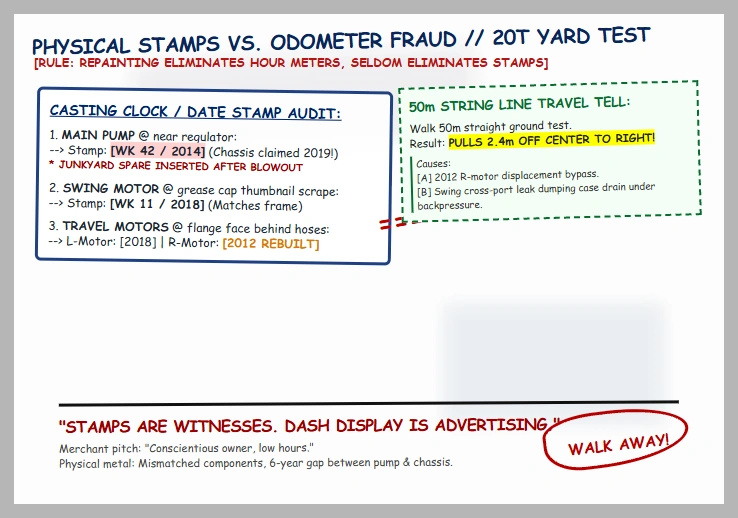
Data sources for the table above:https://www.ironplanet.com/ironclad-assurance
Stamps are witnesses. If there’s a couple of years of preceding the machine, the stamp is spare parts, and that is a whole additional question of why.
Repainting eliminates hour meters and repainting seldom eliminates stamps since no one takes the trouble to grind off a date code on the swing motor prior to flip. Therefore, be sure to see the stamp before taking the display.
Record the Results as pre-shipment conditions on a component and measurement, NOT a feeling. No, not “hydraulics checked & OK”—this sentence has never been a protection for a buyer ever in the history of the trade. Instead: The main relief measured at the pump port compared to the OEM tag value and recorded with the gauge serial number; the pilot pressure was recorded hot and not cold; the cycle times were recorded as three with the difference noted; the unit return element was cut and photographed and the metallurgy was described in the inspector’s own words; and the pump and swing motor date codes were photographed in place prior to cleaning.
Thus, glean what you know about applying standards and target them towards machines that have already done the job. See excavators with available oil analysis history–those not accompanied by a fresh oil pail sitting behind them, or who have a cycle time recorded“hot”by someone who knows that“hot”means something bad. Then go through and cross out by evidence not by paint.
Bring a clip board with you. Leave with numbers.