
Mini Excavator Undercarriage Wear Mapping: Steel Track vs. Rubber Track Failure Modes and Where to Look First
Now the Rust Line is a thing that no one wants to stoop down for.
The least functional perspective that can be used on a rubber track is the standing height. The mirror, which is called an “idler”, and the track frame are there, and the only view is looking through a $25 binocular, angled up and back into the crescent that’s created by the belt wrapped around the front wheel—and look at the mirror, or you have only your own flashlight to look at. For many years, I had wrong angle! Once it is you are staring at the point of greatest flex (solid working on every turn) and the inside face is a much truer account of things than anything on the outside.
I think it has to be the find that I can’t stop going back to – rust. Belt at about 1800 hours (outside) was good enough that no thought is given to a wet scouring pad colour on the outer, with a wet iron smell in a closed shed (away from traffic) and three narrow rust lines along the lug roots in the same orange-brown of oxidised steel cord wire. That is corrosion working out from the inside: it’s not the cord was delaminating which is most often the case, but moisture did and the moisture corrosion front was moving faster than the delamination front, and surfaces in areas where the belt does not appear structurally compromised. I’ve pulled belts where the discoloration was one inch wide, from the belt lug root and the belt had another season on it and I’ve pulled belts where the discoloration was all the way across where the guy was two mud holes from letting go. The second type is much more prevalent that the rental yards will agree.
At lug root test not visual.
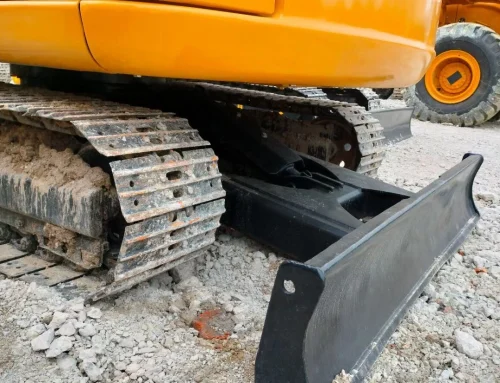
To check rubber out, gently press a thumb into the rubber at each of the bases of a lug: Good rubber will feel resilient and recover; bad rubber will feel as if it is giving and have a waxy consistency. Healthy sections are dull and solid sounding and fatigued sections will be flatter and deadlier sounding. This will take a total of 10 seconds but it will cost you nothing. Nor is the amount of loss linear: the last few millimetres of lug loss occurs three times as quickly as the first few millimetres after the roots begin to give way so a belt with moderate amount of lug loss, and rusted roots is closer to the end, than a belt with just a little less lug loss and a clean inner face. Rubber tracks will have a distinct failure sequence, lug root, inner carcass, and edge bead; and most inspections will follow the reverse order of failure, since the edge bead can be seen easily. I happened by a bead of black silicone around a flaking over seam that came close to being pro at arm’s length. Cosmetic patch/structural failure, rust line remains 3 inches from the end of sealant.
Tangent mirror at the idler, mirror at the sprocket, thumbnail to the root of the lug, knuckle on the edge of the belt. 4 minutes per side and the outside face is the last one to be checked as it fails last–that is the one face everyone takes a photograph of.

All too often, the easiest way to gauge weight is by considering these ten links.
Most chain pitch problems can be resolved simply by using $15 tape, a rag and 10 consecutive links. Properly clean the pin faces to ensure measuring metal to metal, measure the tape from the centre of the first pin to the centre of the tenth pin then read it. Against nominal pitch, times ten is a ratio of elongation–I won’t numerically state the number of millimetres because it varies according to part number and without the against nominal pitch is ‘New York City data’ in disguise.
The monitoring zone is approximately 2% high of the factory. I have seen machines going through that window for another season on light grading (light duty) and others in the same window bust a sprocket in 6 weeks, on rocky side-slope work. 2-3 percent, between two and three percent the tape says, that’s a decision; it’s a decision made by the duty cycle. It’s done if it’s more than three percent.
Furthermore, don’t let the agony of detail also creep in: a February-morning’s temperature of a chain is different from a chain that’s been taken out after two hours of work. Several tenths on the ten—which thrashes a boundary call from two to two-and-a-half percent. Repeat the above procedure with the same ten links but measure the hot, recording the ambient temp on the sheet; if it is more than a millimetre out, then clean pins once again.
The reasons for these two identical 305s wearing in the opposite direction.
The best opportunity to compare machines is two machines, the same yard, model year, less than 3,000 hours, same contractor and same dealer and the same service schedule–and opposite wear signatures! The first had concentrated wear on the outboard shoulder (left side) of the front idler flange and a very narrow, untouched outboard shoulder and inboard shoulder was dull, a 4 mm wide rib was bright and shiny. The second was completely symmetrical, earning its two weeping bottom rollers based on the seals–forward by any criteria at this hour mark. I doubt that I would be improvising that very night, I hesitated, because both bad idler and bad seal batch were possible, and neither can be discounted due to the same dealer performing the same feat on both.
They were split by duty cycle which had identified in the contact patches. In the case of one of these machines, it had ALWAYS side casted, and steered the frame to one side all day, resulting in continuous operation under high lateral load in one direction, slowly walking the frame off center of the chain path, thus sending intense load to the idler flange where it should not be happening. Asymmetrical flange is a diagnostic, not a wear finding: It’s a report on where they have pointed the machine over the 2,000 hours! Yes it was confirmed by the contact roller and I noticed the polished band was not central, it was rolled on the same side to the other, only happens when the chain is not central on the frame, it runs off-centre.
Machine two provided a more positive tale–even everywhere, frames square and seals gone at 3000 hours, which sounds like straight trenching in slurry–a grit and immersion operation, not the impending show of interest in the wear surface. Moreover, there was a rag inserted under the seat no one had occupied in a three-week period. Irrelevant. I didn’t care, and wrote this down.
What’s tricky is, both hour meters tell the truth. Both were indeed run for 3,000 hrs. Time is the least interesting variable in an undercarriage and the entire cat 305 excavator wear breakdown discusses that argument at length: One idler flange has much more lateral load put through it in an afternoon on a cat 305 put down on a slope for side-casting than it does in a month put through it by a cat trenching straight sand. Read the pattern. In a hand that the meter cannot forge it’s a work history in metal.

What did I miss on the money pot by when I made my first guess on it?
Track tension, specified without a temperature is not a specification, it is half a specification, and the other half is the cost of it. I had one belt tensioned as per their instructions in the book and driven for half an hour last November and stored in frost overnight at the dealers. By the morning, it was drum tight, almost not moving to the gauge, felt like a plank of wood, flat in my hand. When they use cold rubber and cold steel, the belt shortens (against a fixed idler) and the 25º temperature tension becomes a more perceptible tension at 5º…Nobody re-checks!
So after an hour of trying to solve it I finally read it after some bit of hand/finger magic removing the mud from the link gaps (packed mud does an impressive job of simulating correct tension when the gauge is placed over the belt and not under the chain.
Bullet points — tension failure modes:
I have about four over tensioned machines for each loosened machine in my notes. The gauge will show more than the number if the motion is observed: if it is correct as the belt is stretched it will move slowly and then a stiffening of the belt gives the characteristic knee in the curve, and that is the curve point I am looking for. All immediate give that is smooth is loose. There’s virtually no play that isn’t tight, and none of the scale readings will reveal that information as well as your hand.
Answers are straight and there are Four Checks.
By concentrating harder and harder, you can’t check a rubber track, you cannot see the inside of, by looking at the outside harder and harder. A screw eye at the Idler tangent accelerates the process by a factor of 20 – a thumbnail test concludes the thing in 90 seconds. A mirror is priced at $11.
Elongation is a maintenance and replacement trigger based on the ten link method which is measured at each service and then replaced when more than about three per cent is measured above the Factory elongation for the service chain. There is no tape which will give you this between two and three – according to the work.
Asymmetric idler flange wear is never an idler problem, it’s a statement on how the machine was pointed and the side on the flange that is worn indicates the direction in which the operator threw the spoil.
So seller’s wear percentage is no different—when you ask a seller what their wear percentage is, there is a requirement that you follow it up with what 10 links, what pin faces is it hot or cold, and what’s the baseline? The truth is, most of the time this comes out of what is called an hour meter which measures time and only time. Please state the measurement, don’t give me the answer to draw your own conclusion.
Corrected order:
Corrected order: Mirror at idler tangent, Mirror at sprocket tangent, Thumbnail & Knuckle at the root of the lug, Tape across 10 cleaned pins, gauge on tension hot, temperature noted, then outside face last. Approximately 11 minutes each side – shorter time than what two individuals would spend debating whether or not their tracks are shot.
The one-line rule–examine what the machine “obscures” before what the machine “shows.” The belt breaks from the inside, the paper begins to fall apart from the inside as well.
Dale was correct but about the order and his belt failed in the season that he called sound.