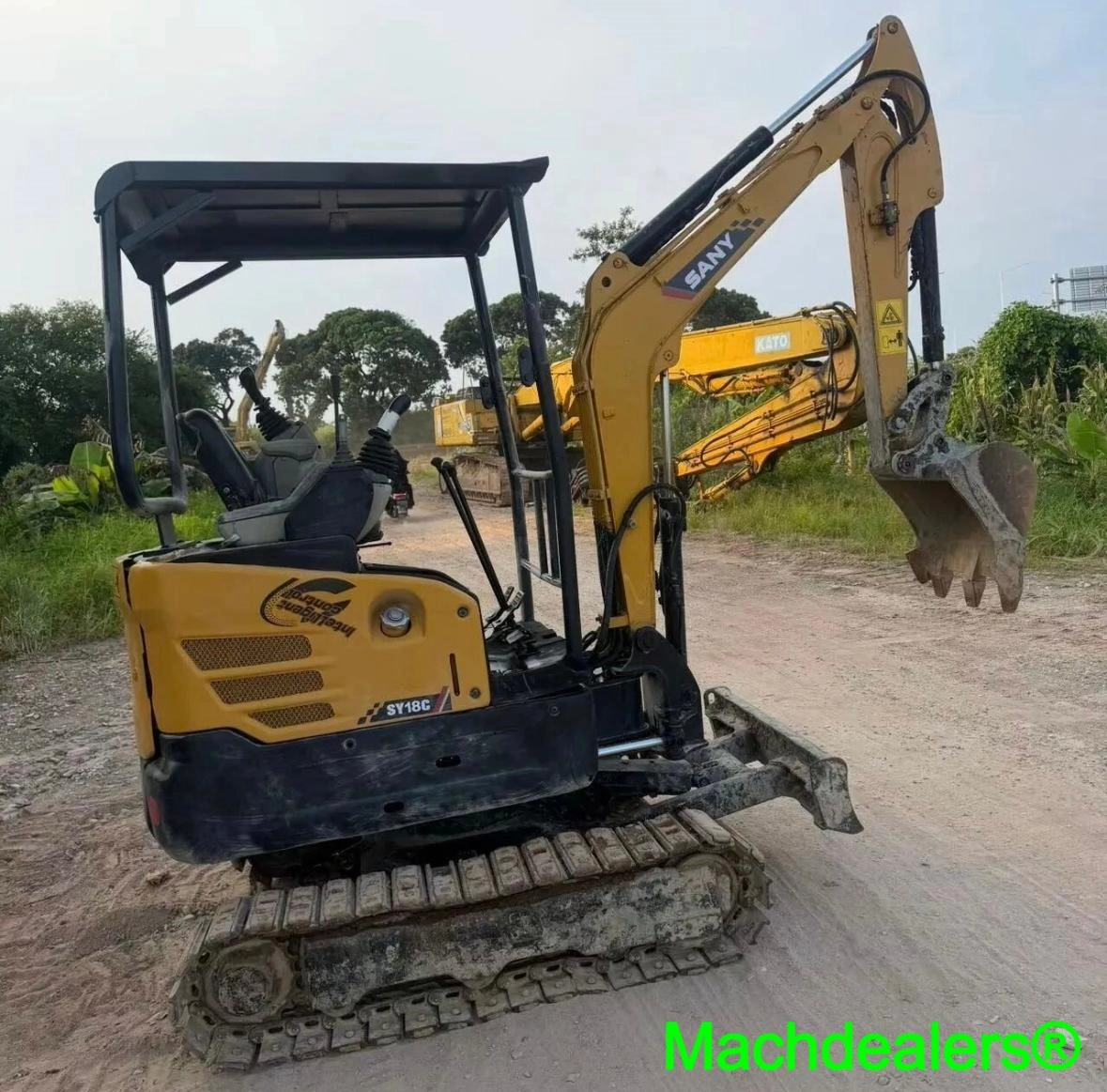

Zero-Tail-Swing and Compact-Radius Excavators: The Duty-Cycle Damage Buyers Never Inspect
It had extended six inches over a thirty-metre stretch and by the time I received a call the man on the string line, the laser, the grade checker, the boy with the shovel and then the ground wall themselves had all had their say and the job is generally a waste. The dirt can’t be right, everyone wants that to be wrong. It was the ring.
Follow it physically and the bad guy no longer is mysterious. The compression does not bend the arm, but passes through the arm nose, the boom boss, the boom foot pin, the weldment of the slew platform and down the bolt circle and finally out through the center joint and down into the undercarriage. All those junctions are being called upon to perform a duty they were never intended and this is led to loads and strains that the building was never designed to withstand. According to the chart”reach”is indicated. It is used by the operator as a press.
The part that is more tricky of all is the center joint, which rarely fails and is taken for granted when there is a problem. King posts and rotary unions get worn down and do not call out as swing issues. It manifests itself as a machine that will fall out from under you when it’s under load, as a miniscule “wobble” at the end of a slew, as a seat pan that shudders when you boom down on the bucket pinned.
Now I get obsessive, and I’m not proud. Take apart the rotary union on a machine which has performed some confined-site work, and check the O rings before checking the steel. Picking off a healthy nitrile ring yields a round that has some semblance of a healthy glow and is a bit fighty when rolled between thumb and forefinger. A ring that has been living at temperature deforms off-square, you can feel the flattening of the cross section, you can see the disenamoured surface on the ring, it’s dusty and chalky and won’t budge with new grease. Squeeze it, it will not leap spring. That is compression set and when a seal has taken compression set it is no longer a seal and is on’luck’ only.
If you have a ring like this set in front of you as new hands, you see it and think,”Serviceable, it’s whole.”It is a default indicator of the machine–not the inspector. As soon as the oil is thinned on a hot summer afternoon, the seal has no”ju-ju”left, and if a sealing press leaks under load, a hot summer afternoon will produce a swing circuit that will never create any pressure.
Writing this takes me back to a Tuesday afternoon when I was out looking at a machine, both shed doors partially open to the wind, cardboard (under my knees) in front of the phone with the OEM parts diagram open, and half eaten lunch somewhere to the rear of my lease, and the seller asked me if I wanted coffee. No I didn’t want to drink coffee. I wanted him to put his mouth shut, so that I could hear if the dye moved.
Every time, penetrant is first on the yoke, before. Not that I think of magnetic particle work as less desirable–it’s not–but that dye most easily penetrates the toe of the weld when the light is poor, and access is poor, and that is the situation that most of these machines present. You wipe them down, you spray them, you wait, you wipe them down, you observe them. What you are looking for is the source of the bleed-out, and what it does. An indication that is moving along a ripple valley is an indication of a crack path and not a surface scratch. An indication which ends up at weld toe only without travelling farther is another prospect.
Then the yoke is removed for anything the dye marked, and for zones where the dye cannot reach (behind the boss, underneath the reinforcement plate, etc. etc. – where a beam of a flashlight from the front will never reach). Angle of the light is more important than the number of watts. If the welding seems nice in the beam at a raking angle at knee level, it will appear as a”smudge”with a straight on beam and some customers will say”it’s lovely, it’s a clean weld,”and it couldn’t be a cleaner weld when they use a beam unable to show any geometry. They weren’t lying. They were wrong to look!
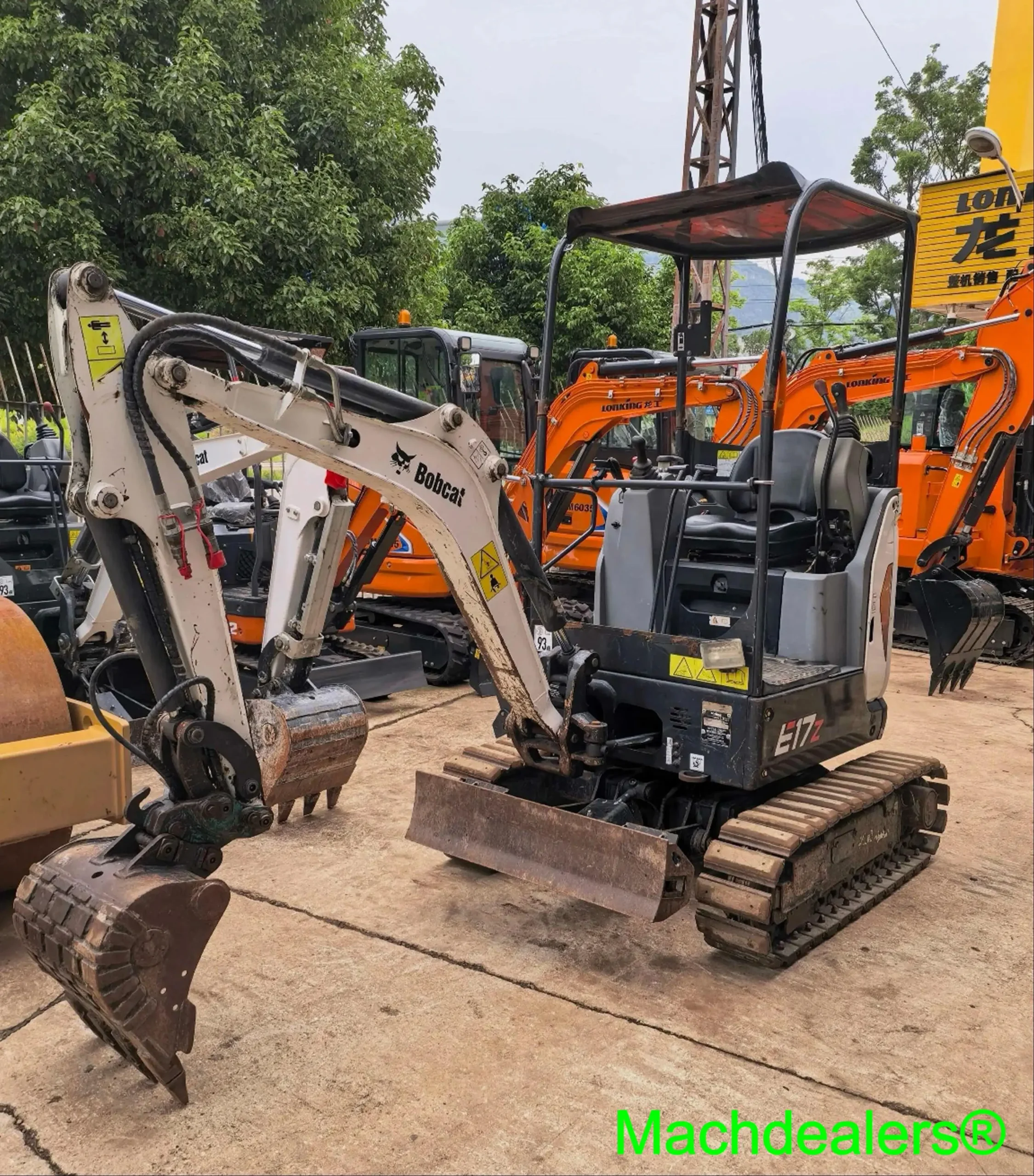
Priority zones: boom boss, arm nose and then ring to deck weld of the slew platform. The consequences of having the same-size indications for each of those three spots shouldn’t be equal, and that is where the difference is from a check to a checkup. If the machines come with an arm nose that has been pressing against wall, then a hairline at an arm nose is a load path signal. The exact same sorts of hairlines on a platform weld could be simply a fabrication artifact resting there, since the machine was constructed. This equates to half a millimetre up or down. Two very different discussions! This number may seem insignificant until you’ve drafted and witnessed the “repercussions” for confusion with these types of calls.
I’m not going to be able to give you a percentage of detection rate. I don’t believe any of them, as the number is based on whoever was doing the cleaning, how long they waited, the ambient temperature at the time and whether or not the person holding the can was asleep. The results of one repeat inspection (same zone, same tech/one season older) are more important than any and all figure.
Bead Ripple, Grinder Marks and the Plate Not in the Parts Book
This is the signature and it’s more difficult to duplicate than paint-match. The extra rhythm of putting down the work in a factory–uniform heights from the crowns, uniform spacing, consistent locations of the tieins in relationship to each other, pass after pass. A hand laid field bead is broad, more apt to set in places, and it finds its way around. Check the lap line connecting repair bead to original fabric–at the lap line, the spacing between the ripples will double, a step will be visible, or a doubling of the heat affected zone will occur at the lap line.
The reinforcement plate is the one that has a close-up effect to sales activity. Owners who have found out the hard way and shops who knew what they were repairing have added plates to boom side plates and boss areas, and there is nothing wrong with the plate per se. Documentation-less operation: If any question comes up, do not eyeball a fabrication and compare it with a picture of a fabrication, confirm by part number against the diagram. If the plate has not been included in the parts book or included in the service record, then you’re footing the bill for somebody else’s engineering organisation.
Was this Breaker’s Home?
No yard tools are needed. It takes about 15 minutes, and the anxiety to appear foolish.
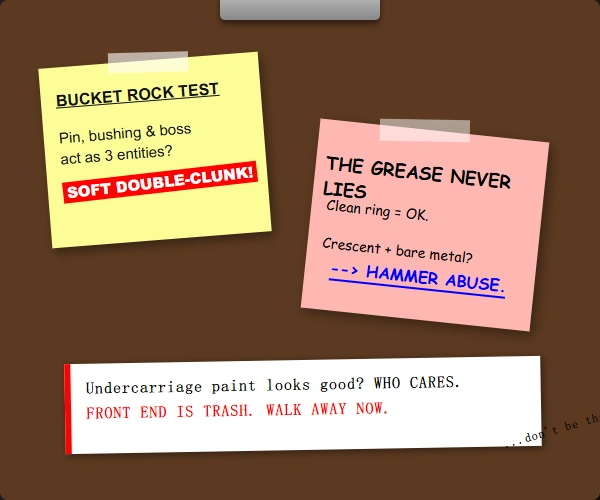
Curl the bucket up make a complete circle and rock the bucket. There’s a slop point there where the pin, the bushing and the boss cease to act as one unit and become three entities–it’s a soft double-clunk as opposed to one solid stop. Remind the same story under a smaller load with changes in direction. All you have to do is take a look at the grease pattern on the boss to determine the answer: a clean ring of grease means someone has been paying attention; a crescent pattern of grease with a bare ring of metal at the opposite end indicates the load has been travelling in one direction for quite a long time.
None of these is proof per se. As a combination they are a picture of a machine that has spent much of its service life on a hydraulic hammer, and the memories of its front end betoken that, but not the undercarriage. In the same way, the undercarriage can be good and the front finished – I have seen good paint on the front end of a machine with a boom that’s been welded twice and a ring that was east of its expiration date, and the buyer spent his inspection looking at the tracks, as everyone knows to do.
Data sources for the table above:https://blog.rbauction.com/equipment-inspection-tips-skid-steer-loaders/
A last test will be performed by the gesture from the opening still. Palm flat on deck plate, lean to left slow and reverse. On a clean machine, you only feel the hydraulics—no hesitation as you’re travelling up through the heel of the hand, no hesitation at the reversal, just pure hydraulics. That is the best of all information–which is missing–and it comes at the cheapest price of dirty palm and two minutes of the operator’s time during the inspection.
Or work back the other way to the paperwork. Check out the zero tail swing units which are currently in the market and request a quote, and request boom boss close ups in the same message. Only a couple of machines come back with a “clean deck plate reading” and with a genuine bead signature, so those machines are worth your afternoon.