
Why a $150 Oil Sample Could Save You $34,000 on Used Heavy Equipment
He’d just bought a Komatsu PC360-7 at a regional auction. The auctioneer had called it “barely broken in.” He paid $182,000, financed half of it, and put the machine straight onto a pipeline job in West Texas.
The pleats looked like they’d been dipped in bronze glitter. I sent a sample to the lab anyway, even though the machine was already dead.
The seller had changed the hydraulic oil two days before the auction.
The bronze thrust washers in the swing motor had been disintegrating for at least 600 hours, maybe more, and the new oil made everything look clean and amber under the reservoir sight glass. My friend never thought to pull a sample. He trusted the hour meter, the paint, and the fact that the machine started cold without smoke.
He learned a $34,000 lesson. That’s what the swing bearing replacement cost, plus downtime, plus the labor to pull the upper structure. A lab analysis costs $150. The sample bottle is free.
The Inspection Blind Spot Most Buyers Have
They’ll spend two hours inspecting undercarriage wear—counting the millimeters left on track pads, checking sprocket teeth for hooking—but they won’t pull a 100ml oil sample from the hydraulic tank. I’ve seen buyers crawl under a machine with a flashlight to check for frame cracks, then hand over six figures without ever knowing that the hydraulic pump has been feeding itself to the system for the last 400 hours.
The 336F I Walked Away From
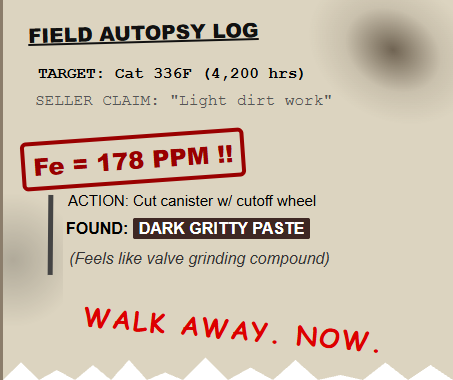
Last year I looked at a Caterpillar 336F—2016 model, 4,200 hours, owner claimed it had been on light dirt work for a municipal contractor. I pulled three samples: engine oil from the sump, hydraulic oil from the mid-depth point in the reservoir, and final drive oil from the left travel motor. All three came back from the lab within 36 hours. The engine oil showed 62 PPM iron, 18 PPM copper, 6 PPM chromium. Textbook wear for that hour range. The hydraulic sample came back at 178 PPM iron and 14 PPM copper.
I walked away from the deal.
The seller was confused. Hydraulic pumps and motors operate with clearances measured in microns. The piston bores inside a variable-displacement pump have a fit tolerance around 8 to 12 microns. When ferrous particles in the 10 to 40 micron range start circulating, they act like loose grinding compound. They get between the piston and the bore, they score the cylinder block, and they accelerate wear exponentially.
Understanding PPM Levels: What the Numbers Mean
Hydraulic System Iron Levels
Normal iron levels in a hydraulic system—assuming clean oil, good filtration, no cavitation—sit below 25 PPM for the first 2,000 hours. Between 2,000 and 5,000 hours, you’ll drift up to maybe 40 or 50 PPM as the pump’s slipper pads and swashplate wear in. Anything above 100 PPM means something is wrong. Either the machine was run with a collapsed filter, or it ingested debris during a hydraulic line repair, or—most common—the pump has been cavitating because someone let the suction strainer in the tank clog up with sludge.
The iron particles are grinding fresh iron off the pump, which makes more particles, which grind more metal. It’s a mechanical avalanche, and the only way to stop it is a full system flush, new pump, and probably new motors. On a 336, that’s a $28,000 job if you’re lucky.
I went back to that seller’s yard the next day and asked if I could pull the hydraulic filter. He said sure, no problem, he’d just changed it at 4,000 hours. I cut the canister open with a pneumatic cutoff wheel—still had my safety glasses on, standing there in the gravel parking lot—and when I peeled the pleats apart, there was a fine brown sediment packed into the upstream side. Just a dark, gritty paste that felt like valve grinding compound when I rubbed it between my thumb and forefinger.
Data sources for the table above:https://www.cat.com/en_US/by-industry/electric-power/product-support/maintenance-and-support/sos-services.html
Engine Oil Iron Levels
Engine oil: Below 50 PPM is normal break-in and operational wear. You’re seeing microscopic particles from piston rings bedding into cylinder walls, cam lobes burnishing their respective lifters, crank journals polishing the main bearings. Between 80 and 150 PPM, you’re into accelerated wear—rings aren’t sealing, valve guides are sloppy, or there’s scoring on a cylinder wall. Above 200 PPM, you’re in the failure zone. I’ve seen reports at 340 PPM where the engine was still running, but it was making oil—fuel dilution through blow-by—and the next step was a spun bearing.
Drive
drive: drives run lower oil volumes and higher pressures, so you’ll see slightly higher baseline iron—maybe 40 to 60 PPM is acceptable. But above 120 PPM, your planetary gears or ring gear are wearing hard, and you’re six months from a howling noise and a $9,000 rebuild.
Rate of Change Matters
A machine that goes from 35 PPM iron to 95 PPM in 200 hours is dying faster than one that’s been sitting at 70 PPM for 1,500 hours. But you’ll never know the rate unless you ask the seller for historical oil analysis reports—and most of them won’t have any.
Copper: The Bronze Component Warning Sign
Copper comes from bronze and brass components—bushings, thrust washers, oil cooler tubes, and in some hydraulic motors, bronze valve plates. Normal wear puts you below 30 PPM. Between 60 and 120 PPM, you’ve got a bushing or thrust washer that’s running dry or misaligned. Above 150 PPM, you’re watching a component die in real time.
I pulled a hydraulic swing motor off a Volvo EC480D two years ago. The oil sample had come back at 290 PPM copper. The owner thought the lab made a mistake. When I split the motor case—had it on the bench, still warm from the machine—there was a bronze thrust washer inside that had worn down from its original 3mm thickness to about 0.8mm. You could see the tool marks from the lathe on the back side of it, but the wear surface was mirror-polished and concave. The mating surface on the steel end cap had a copper-colored transfer coating, almost like someone had rubbed a bronze crayon on it.
Bronze bushings don’t wear out in 2,000 hours under normal conditions. They wear out when lubrication fails—low oil level, clogged passages, or prolonged operation at max pressure without rest cycles.

Chromium: Detecting Cylinder and Rod Damage
Chromium comes from hard-chrome-plated piston rings, chrome-plated hydraulic rod surfaces, and to a lesser extent, stainless steel components. In an engine oil sample, normal chromium sits below 10 PPM. Between 15 and 30 PPM, you’ve got piston ring blow-by or cylinder wall scoring—probably from ingested dust or a collapsed air filter. Above 40 PPM, the cylinder walls are eroding, and you’re looking at an overhaul.
There’s a visual phenomenon that happens when hard chrome delaminates from a rod surface under heat and pressure—it leaves this faint rainbow haze, almost like an oil slick, where the base steel is starting to show through. You won’t see it unless you’re looking at the rod in direct sunlight, turning it slowly in your hands.
The first time I saw that haze, I didn’t know what I was looking at. I thought it was hydraulic fluid staining. Then I ran my thumbnail across it and felt the step—a microscopic ridge where the chrome had peeled back. That machine had 67 PPM chromium in the hydraulic sample. The cylinder rods had been flexing under side load, and the chrome was spalling off in flakes too small to see but large enough to measure.
Reading Metal Ratios: The Diagnostic Fingerprint
A healthy machine with normal wear will show a proportional relationship between iron and copper. You’ll typically see an Fe:Cu ratio somewhere between 3:1 and 6:1 in a hydraulic system. For example, 90 PPM iron and 18 PPM copper—that’s a 5:1 ratio, and it tells me the pump is wearing at a normal rate, bushings are fine, everything is aging together.
But if I see 90 PPM iron and 110 PPM copper, that ratio is inverted. It means someone swapped the hydraulic pump—probably because it failed—but they left the motors and valves alone. The new pump is making fresh iron wear at startup levels, but the old motors are still feeding copper into the system. That’s a Frankenstein machine, and I don’t want it.
Same logic applies to Fe:Cr ratios in engine oil. If I see high chromium but low iron, it tells me the rings are shot but the crank and cam are fine—maybe the machine ingested dirt through a torn air filter boot, wrecked the rings and cylinders, but the bottom end survived. If iron is high but chromium is normal, I’m looking at bearing wear or cam lobe scuffing.
How to Pull Oil Samples in the Field
I carry sample bottles in my truck—small HDPE bottles with screw caps, labeled with a marker. You can buy them from any oil analysis lab for free, or you can use clean pill bottles from a pharmacy. What matters is that the bottle is clean and you don’t cross-contaminate.
Engine Sump Sample
Engine sump is the easiest. Most machines have a drain valve on the bottom of the oil pan—Caterpillar uses a quarter-turn valve, Komatsu and Hitachi usually have a pipe plug. If the machine is cold, you’ll get a sample, but it won’t be representative. Oil needs to be at operating temperature—around 180 to 210°F—so that any settled particulate is suspended and you’re capturing the true contamination load.
I ask the seller to start the machine and let it idle for ten minutes. I tell them I want to check for smoke, listen to the injectors, whatever. What I’m really doing is heating the oil. Then I crouch down next to the oil pan with a sample bottle and a pair of nitrile gloves—because hot engine oil will absolutely burn your hands—and I crack the drain valve just enough to fill the bottle halfway. 100ml is all you need. I don’t take from the bottom of the pan where the sludge settles. I don’t skim from the dipstick. I want mid-drain flow.
If the seller asks what I’m doing, I tell them the truth: I’m pulling an oil sample for analysis. Most of them don’t care. The ones who do care are the ones I’m about to walk away from anyway.
Hydraulic Reservoir Sample
Hydraulic reservoir is more delicate. The reservoir on most excavators has a sight glass and a fill cap on top. Some models—like the Komatsu PC200-8 and the Cat 320E—have a drain valve on the side of the tank. Others don’t, and you have to pull the sample from the top.
You want mid-depth. That means measuring the tank—most hydraulic reservoirs are around 16 to 20 inches deep—and inserting your suction tube to half that depth. I use a length of clear vinyl tubing attached to a hand-pump syringe. Insert, pump, fill the bottle, done. The oil should look amber or slightly brown. If it’s black, you’ve already got your answer and you don’t need to send it to a lab.
Drive Oil Sample
drive oil is the sample most people skip, and that’s a mistake.
drives are isolated systems. The oil in the final drive doesn’t mix with the hydraulic system or the engine. It’s a sealed planetary gearbox with its own oil supply—usually around 4 to 6 liters per side—and it only gets contaminated if a seal fails or if the gears themselves are wearing.
The machine spent 1,500 hours in a muddy rail yard, water got past the travel motor seal, the final drive oil emulsified, and the planetary gears started rusting. The oil turns gray. Feels gritty. Smells sour.
On a Caterpillar 320 or 323, the final drive has a magnetic drain plug on the lower outboard side of the housing. You need the machine on level ground, and you need a 24mm wrench or a large Allen key depending on the year. Pull the plug, and before you even drain the oil, look at the magnet.
If the magnet comes out clean—maybe a light fuzz of ferrous dust—you’re fine. If it comes out looking like a porcupine, with metal needles a quarter-inch long stuck to it, you’re looking at gear wear or a spalled bearing race. I’ve stood in a seller’s yard and pulled a final drive plug where the magnet had so much metal on it I couldn’t see the plug threads. He’d never checked it.
I wiped the metal off on a shop rag, smiled, thanked him for his time, and left.
The Economics of Oil Analysis
A spectrometric oil analysis from a reputable lab—Polaris Laboratories, TestOil, Blackstone Labs—costs between $135 and $180 depending on the turnaround time and the test panel. Standard panel includes PPM readings for iron, copper, chromium, aluminum, lead, tin, silicon, and a few others. You’ll also get viscosity, fuel dilution, and glycol contamination if you pay for the expanded panel. Results come back in 24 to 48 hours if you ship overnight.
A hydraulic pump replacement on a Komatsu PC360 or a Cat 336 runs between $12,000 and $18,000 depending on whether you go OEM or remanufactured. Swing bearing replacement—assuming you can even find the bearing in stock—costs $22,000 to $30,000 with labor, because you have to pull the entire upper structure off the machine. Engine overhaul—if you’re looking at scored cylinders and worn crank journals—starts at $28,000 and goes up from there depending on how bad the damage is.
When Sellers Change Oil Before Listing
If someone changes all the fluids two days before listing the machine, they’ve erased the evidence. Maybe they did it to make the machine look well-maintained. Or maybe they did it because the oil was black and metallic and they knew a buyer would notice.
I don’t care which.
What to Do If a Seller Won’t Let You Sample
I make a counteroffer. I tell the seller I’ll pay for the sample, I’ll pay for the lab analysis, and if the results come back clean—if iron is below 60, copper is below 30, chromium is below 10—I’ll eat the $150 and we’ll close the deal the next day.
If they agree, great. If they still refuse, I walk.
The Filter Autopsy Alternative
If the seller won’t let you pull oil but they’ll let you pull the hydraulic return filter, you can cut the filter open and read the tea leaves.
Take it back to your truck. Use a pipe cutter or a hacksaw to cut the canister in half lengthwise. Peel apart the pleats and look at the upstream side—the side facing the return flow.
If the pleats are clean or lightly discolored, you’re fine. If there’s a brown or gray paste, that’s wear metal. If there’s bronze glitter, you’ve got copper contamination. If you see long ferrous needles or chunks of anything, run.