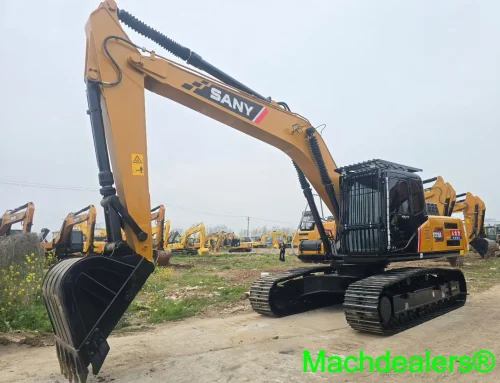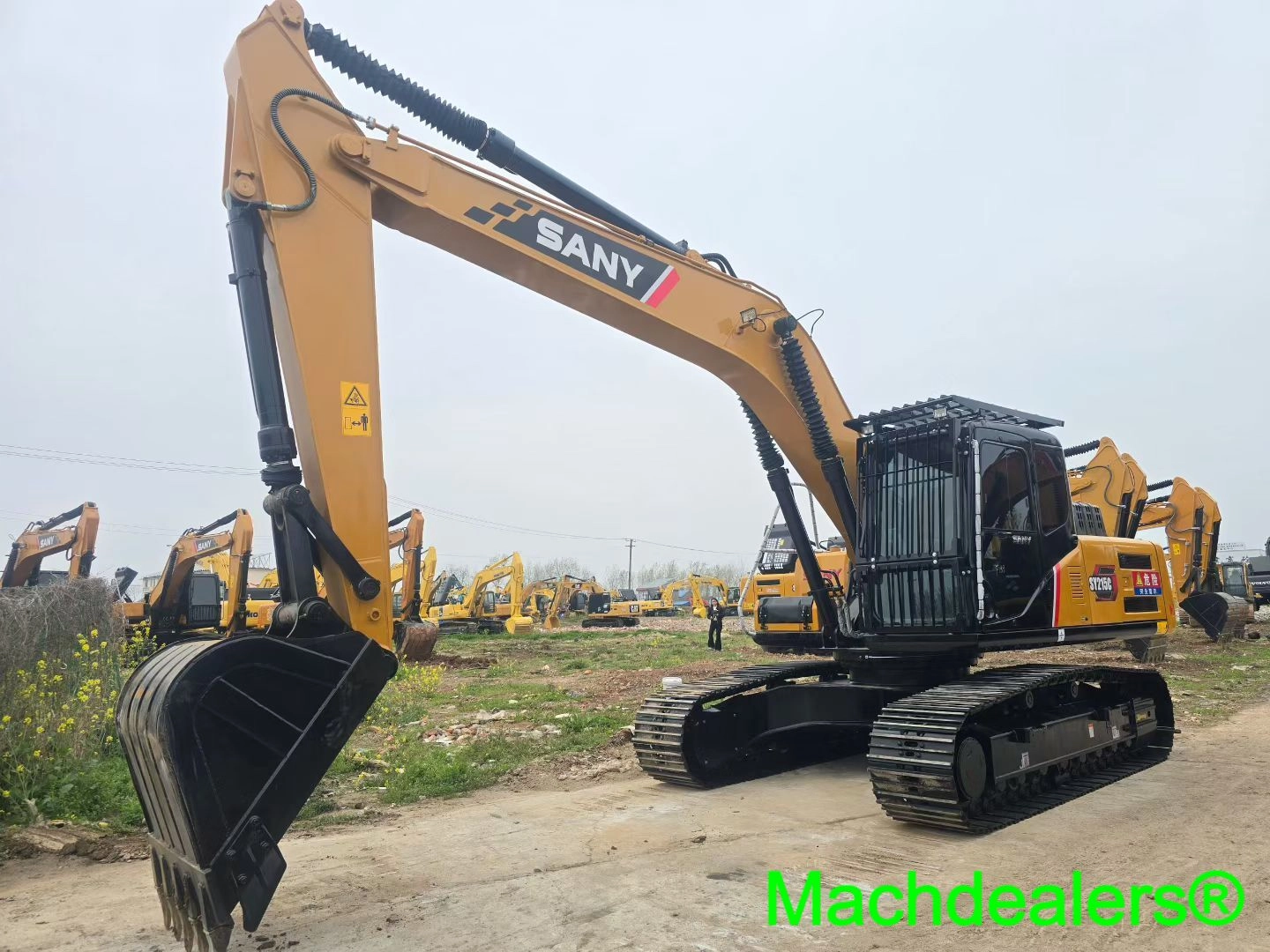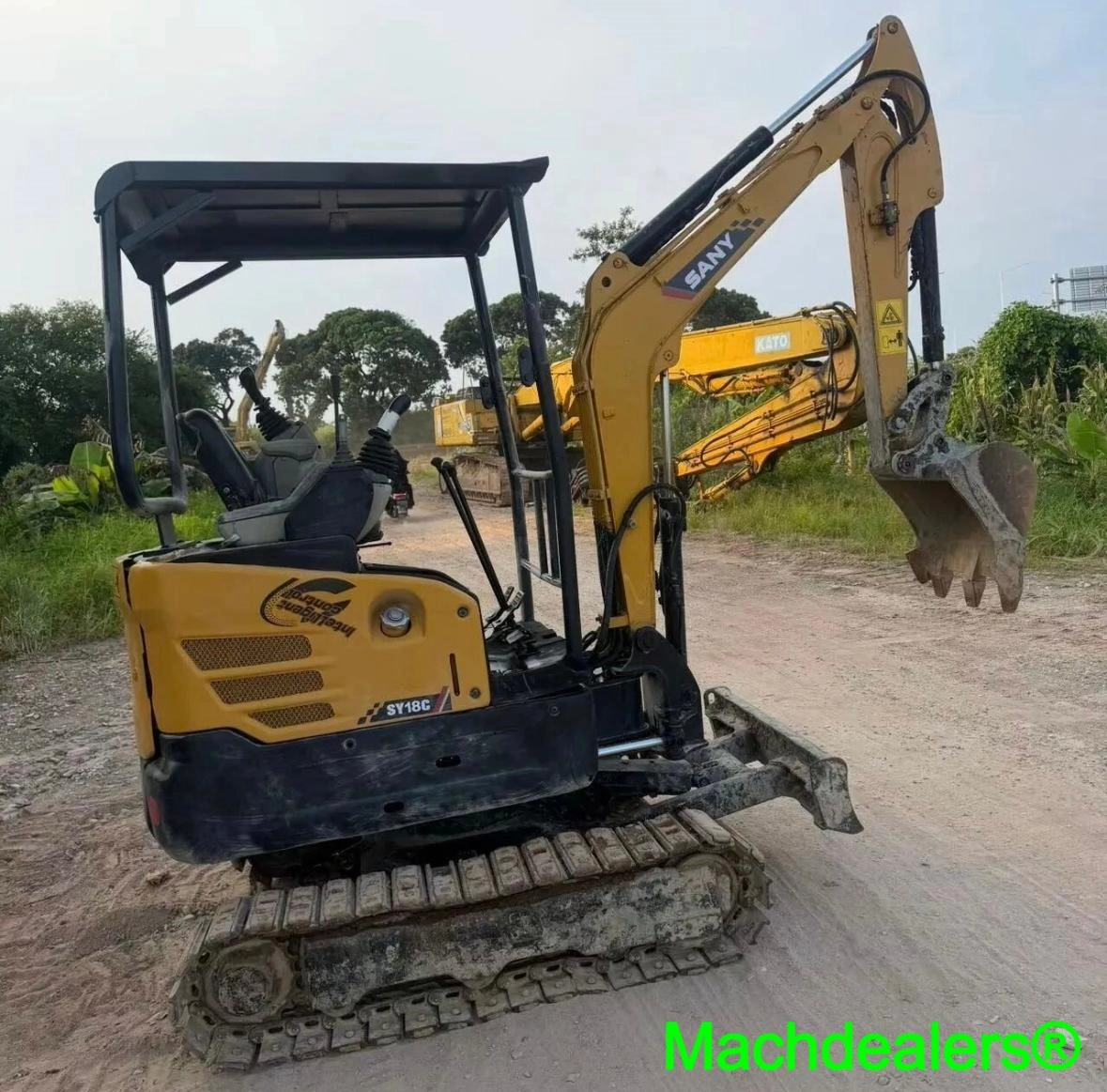

Used Sany SY215C vs SY225C vs SY245H: Which Mid-to-Heavy Class Fits Your Jobsite
There’s a version of this mistake I’ve watched play out more than once on jobsites across Southeast Asia and the Middle East. A procurement team — smart people, not rookies — pulls up the Sany mid-class lineup, sees three models sitting within a relatively close weight band, and decides the choice is basically a budget question. Get the cheapest one available used, swap the bucket if needed, move on.
Six months later, the machine is either tearing up a prepared subgrade it was never meant to work on, or it’s sitting idle because the hydraulic demand on the H-series nobody bothered to read about has turned routine servicing into a recurring cost sink.
This article is a diagnostic tool, not a spec sheet.
The Weight Jump You’re Probably Underestimating
Let me be direct about something the spec sheets don’t explain well. The operating weight delta between the SY215C and the SY225C looks modest on paper — roughly a tonne difference depending on configuration. New buyers see that and think: marginal. Frankly speaking, that framing is wrong, and it costs people money.
That extra mass doesn’t sit evenly distributed across the machine. It concentrates in the upper structure and boom assembly, and it translates directly into ground bearing pressure across the undercarriage contact patch. I’ve crouched down next to both machines on soft clay prep sites and pressed my thumb into the track shoe impressions left after a single pass. The SY225C sinks noticeably deeper — not catastrophically, but enough that on a site with inconsistent bearing capacity, you’re managing undercarriage wear on a curve that compounds faster than most used-equipment ROI calculations account for.
The bucket capacity question is where it gets interesting. The SY215C is commonly paired with a 0.93 m³ standard bucket. The SY225C typically runs a 1.05 m³. That volumetric jump is secondary — what changes is the arm crowd force. The SY225C’s hydraulic system pushes harder at the bucket tip during a full crowd stroke. Run your hand along the bucket teeth on a used SY215C that’s been pushed beyond its rated digging force, and you’ll feel asymmetric wear: corner teeth go first, the middle holds longer. That’s the machine telling you it was asked to do something it wasn’t quite built for.
What the Weight Gap Does to Your Ground Pressure Math
Ground pressure is not just operating weight divided by track contact area. That’s the textbook formula and technically accurate, but dynamic load during digging cycles spikes effective ground pressure well above the static number. When the SY225C is mid-dig on a trenching pass — bucket full, arm at maximum crowd, swing just initiated — the rear of the undercarriage lifts fractionally. Every operator knows this. What the calculation misses is that this cyclic lift-and-drop event, repeated thousands of times, accelerates wear on the front idler bushings and the track link pins at the front of the contact zone.
On a used SY215C with north of 5,000 hours, I’d grab the front idler and check for lateral play before looking at anything else. Less than a millimeter of perceptible wobble and I’m still interested. Anything I can feel clearly with my hand wrapped around the idler flange — walk away, or negotiate hard.
The SY225C handles cyclic stress better by design. Its heavier undercarriage components have wider bearing surfaces. But that engineering advantage flips into a liability the moment you put it on a site with marginal soil — because now you’re combining higher static ground pressure with a machine that can dig harder, and the operator will use that capacity. Simple. Brutal. The ground loses.
Honest decision rule: if your primary work is trenching in firm conditions, the SY225C’s added digging authority is worth the used price premium. If you’re working on fill, reclaimed land, or anything with inconsistent bearing capacity, the SY215C is the lower-risk platform. The weight savings are a genuine operational advantage, not just a budget compromise.

The H-Series Hydraulic Trap Most Buyers Fall Into
Writing this suddenly reminds me of a wildly absurd case — a procurement manager who flew halfway across the country to inspect a used SY245H, spent forty minutes photographing the cab interior, and never once looked at the return-line filter. Not once.
I want to talk about the SY245H’s hydraulic system, and I’m going to start somewhere specific: the return-line filter housing.
On a used SY245H, I pull the return-line filter element before I look at pump pressure readings, before I check the swing motor, before anything else. I hold the element up to natural light and look at the color and texture of the debris embedded in the media. Clean paper-white media with a faint golden tint from normal oxidized fluid: fine. A gray-brown coating that smears when you drag a fingernail across the pleats: someone ran this machine hot, and the filter is holding early-stage hydraulic fluid thermal breakdown. Dark soot-like deposits along the pleat edges: that’s carbon. The fluid cooked. Somewhere in this machine’s history, hydraulic oil reached temperatures that initiated carbonization, and now there are micro-particles of that carbon circulating through every orifice and spool in the system.
The SY245H’s dual variable-displacement piston pump configuration is why this matters more than it does on the SY225C. The C-series runs a simpler pump arrangement with lower peak flow demands. The H-series — designed for higher-demand attachments and continuous high-cycle applications like demolition or rock breaking — runs its pumps closer to their displacement limits during normal work cycles. That’s not a design flaw. That’s the point. But it means the thermal load on hydraulic fluid is substantially higher during sustained operation, and the tolerance windows on the main pump’s barrel plate and piston slippers are tighter.
What’s trickier is that a seller can present a used SY245H with perfectly acceptable hour meter readings and normal-looking external condition, and the machine can still have a compromised hydraulic system — because the previous owner ran it on extended attachment work in high ambient temperatures without tightening fluid service intervals.
Used SY245H Inspection: Where the Hydraulic Hours Actually Hide
“Hydraulic hours” versus “machine hours.” The hour meter counts engine-on time. It doesn’t distinguish between a machine that spent 4,000 hours doing light grading with hydraulic load hovering at 40% of system capacity, and one that spent 4,000 hours running a hydraulic hammer eight hours a day in a quarry at 85–90% continuous hydraulic load. These are completely different machines in terms of component wear state, even if the hour meter shows the same number.
On the SY245H, hidden hydraulic hours show up in the main pump’s response to a full-throttle stall test. With my boots on the cab floor and my hand on the control lever, I crowd the arm hard into a solid face and hold it. A healthy pump — even a used one with legitimate hours — holds pressure without hunting. The engine note drops and stabilizes. The pressure gauge holds steady with minor fluctuation in the range of normal system ripple.
A pump worn past honest service will hunt. I feel it through the joystick as a slight rhythmic resistance variation — not jerking, more like a breathing pattern in the hydraulic force. A test unit I was evaluating once had a pressure gauge needle that kept oscillating slowly, about two to three times per second, never settling. The seller called it a minor calibration issue. I told him the barrel plate was scored and the servo piston was wearing through its centering spring preload. He didn’t sell the machine that day.
The SY225C’s simpler hydraulic architecture — single variable-displacement pump with a fixed-displacement pilot circuit — means this failure mode is less likely on a used unit. The system runs cooler under equivalent work cycles, the pump displacement control is less complex, and maintenance sensitivity is lower. For buyers who can’t commission a proper pump efficiency test before purchase, the SY225C is the lower-risk hydraulic bet in the used market.
The One Question to Ask Before You Wire the Deposit
Forget the hour meter for a moment. The single most diagnostic question you can ask a used Sany mid-class seller: Can you show me the last three hydraulic fluid sample reports?
Not service records. Not invoices. Actual spectrometric oil analysis reports from a third-party lab.
If they have them, read the iron and silicon trend lines. Iron tells you about ferrous wear particle accumulation — pumps, motors, cylinders. Silicon tells you about dirt ingestion — compromised breathers, seals, or improper fluid handling during service. A rising iron trend over consecutive samples is a machine accelerating into a wear curve. Flat or declining iron on a machine with significant hours is a machine that was looked after.
No fluid sample reports doesn’t automatically disqualify a unit. Plenty of used Sany machines come out of operations that did competent mechanical maintenance without running a formal oil analysis program. It means you’re flying partially blind, and your physical inspection needs to compensate.
Three checks that override any spec sheet:
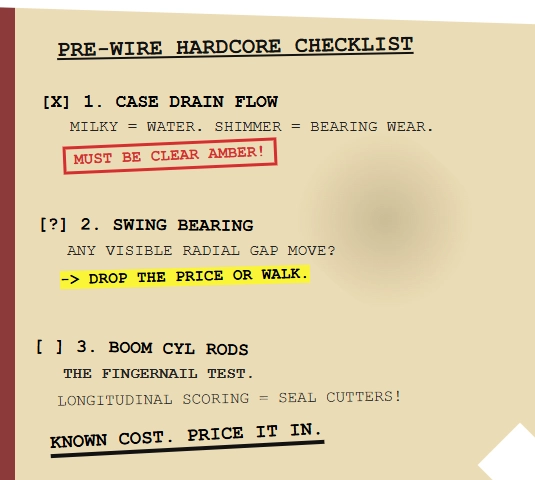
Data sources for the table above:https://www.ritohydraulic.com/blog/pc600-6-hydraulic-pump-wear-how-case-drain-flow-reveals-internal-damage_b103