

Used Excavator Boom and Stick Cracks: How to Spot Hidden Weld Repairs on Sany SY155C to SY365H Before Purchase
I spotted it for the first time when I was in a yard outside of Chengdu on one humid morning, before 8 AM, and I had a half-eaten breakfast-sandwich in my left hand! The sitting one that is the SY225C in the second row looked like it had been uniformly painted. Not clean-even. Uniform-even. The type of “even” that occurs when someone sprays a surface that has already been ground down and filled. That’s not maintenance. That’s concealment.
Let’s look at the facts of mechanics. During each dig cycle in a 15 to 36 ton excavator, the boom arm of the excavator bends. Each stroke is a defined amount of torsional stress at the boom foot (the weld joint between the boom and upper frame), and a defined amount of compression through the stick. Micro-cracks develop at heat affected areas that are near to original factory weld lines over thousands of operating hours. The HAZ is the area of the parent metal which is metallurgically affected and lies just beyond the fusion line of every weld bead. A bead created by the operation of a welder has the effect of refining the grain structure in the surrounded base material, decreasing its ability to resist fatigue load and is the preferred route for crack propagation in a cyclic load. Residual stress is generated as a by-product of the original welding yielding subsequent stress then is added to it when the weld is repaired by a repair shop and re-welded, creating a second HAZ. Afterwards they pound it into a fine flour. Prime it. Paint it. Surface feels like from the factory. The laminates of the subsurface is a bad laminate of overlapping stress risers. Overspray pattern, weld bead burial and filler smear are a confession of structure.
Get low. Low — Crouch and peer along the boom surface at your rake and a flashlight which is almost parallel to the metal surface. It is not the crack that you are looking for. You won’t be able to spot this by just the naked eye underneath that paint. What you need is the lay of the land of a fix. This dressing occurs as a factory weld bead that’s properly dressed and painted to provide a predictable ridge geometry. Since the work area post-repair presents shadows in a different light, a ground area where body filler, weld filler or epoxy compound has been added to the irregular ground will show a different shadow. A surface which doesn’t conform to the geometry of the structure. A region that is a little higher than the boom profile (or a little lower) that was not specifically created.
Another confession — overspray. Look for these places: boom foot gussets, stick pivot ear plates and upper frame rotary joint mounting pads. Pre assembly factory paint has clean color lines with precision masking. Edges of a masker when performed in-the-field become somewhat soft when the mask doesn’t conform to tight angles, corners, etc. Sometimes on curved gusset plates will be apparent a gradient of color density (darker in the spray center and lighter around the edges), which the factory booth will not have. Most purchasers by no means pay attention to this. They monitor the wear of vehicle’s undercarriages. Their gaze falls on his teeth in the bucket. They refuse to go on their knees and place the flashlight along the boom at a 10° angle. That’s the gap.

Pin Point on the Stick is SY155C
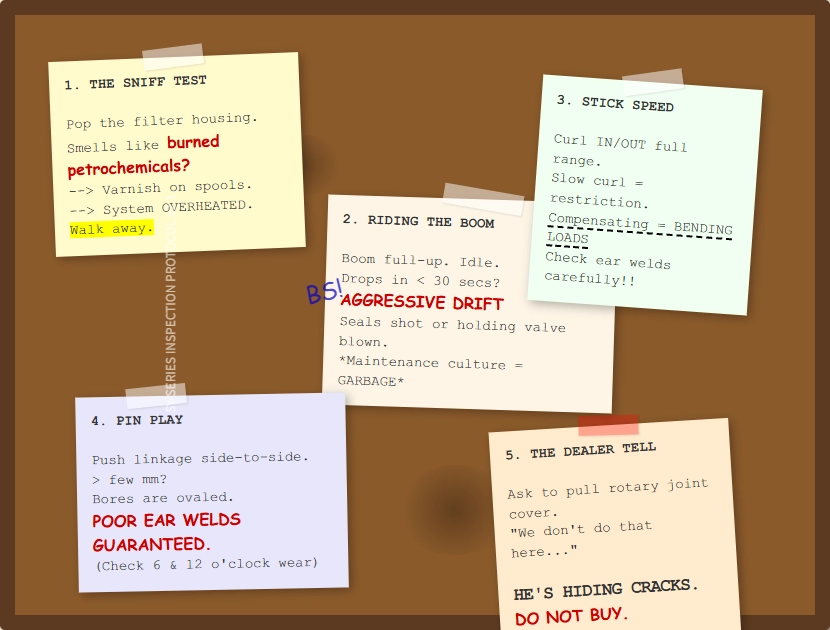
The one failure signature that I’ve seen repeat more consistently than any other, doesn’t occur in the boom on the SY155C. It’s on the Stick to Bucket Linkage Pin Bores. Trenching/crowd force is high frequency, short sticks — this machine is worked quite heavily on that sort of work. The pin bores on the ears of the bucket linkage on the stick fret: this is because the pin does not spin freely in the bore and will over time oval the bore if it is loaded. I remove the pins for the bucket and examine the bore in the light. Surface finish of a healthy bore is uniform around the entire bore. The characters of a worn bore are a bright, burnished contact patch at about the 6 o’clock and 12 o’clock positions; sometimes there is a visible step you can feel with your fingernail that is caused by the bore enlargement at the impact loading points. That is an indicator to me that this machine had the loose pins for a prolonged period of time. Loose pins suggests that the stick ears had to endure bending loads of which they were not intended. Stick ears with fractures contribute light escapes from the pin bore and these would not be evident in the paint around the bore chamfer.
Special SY365H — Upper frame Rotary Joint mount.
Weighing 36 tons when it’s operating, the forces experienced by the upper frame rotary joint are much more multi-directional and of greater magnitude than on the smaller models. The counter weight deceleration of each swing cycle causes a tensile loading of the mounting pad connecting the rotary joint to the top of the frame. Looking for the SY365H, I’d be looking at the rotary joint mounting pad and looking for cracking at the corners of the perimeter weld along the edge of the deck plate to the upper frame (vertical joint). These are re-entrant corner welds (those that focus stress) and part of this detail is covered by routing for the hydraulics lines and the cover for the center joint. The cover needs to be taken off. If the dealer is unwilling to let you remove covers for inspection during the pre-sale, then they are saying something to you.
Five things I check before I will even listen to price for less than 8 minutes.
Data sources for the table above:https://www.cat.com/en_US/articles/ci-articles/your-six-step-excavator-maintenance-checklist.html