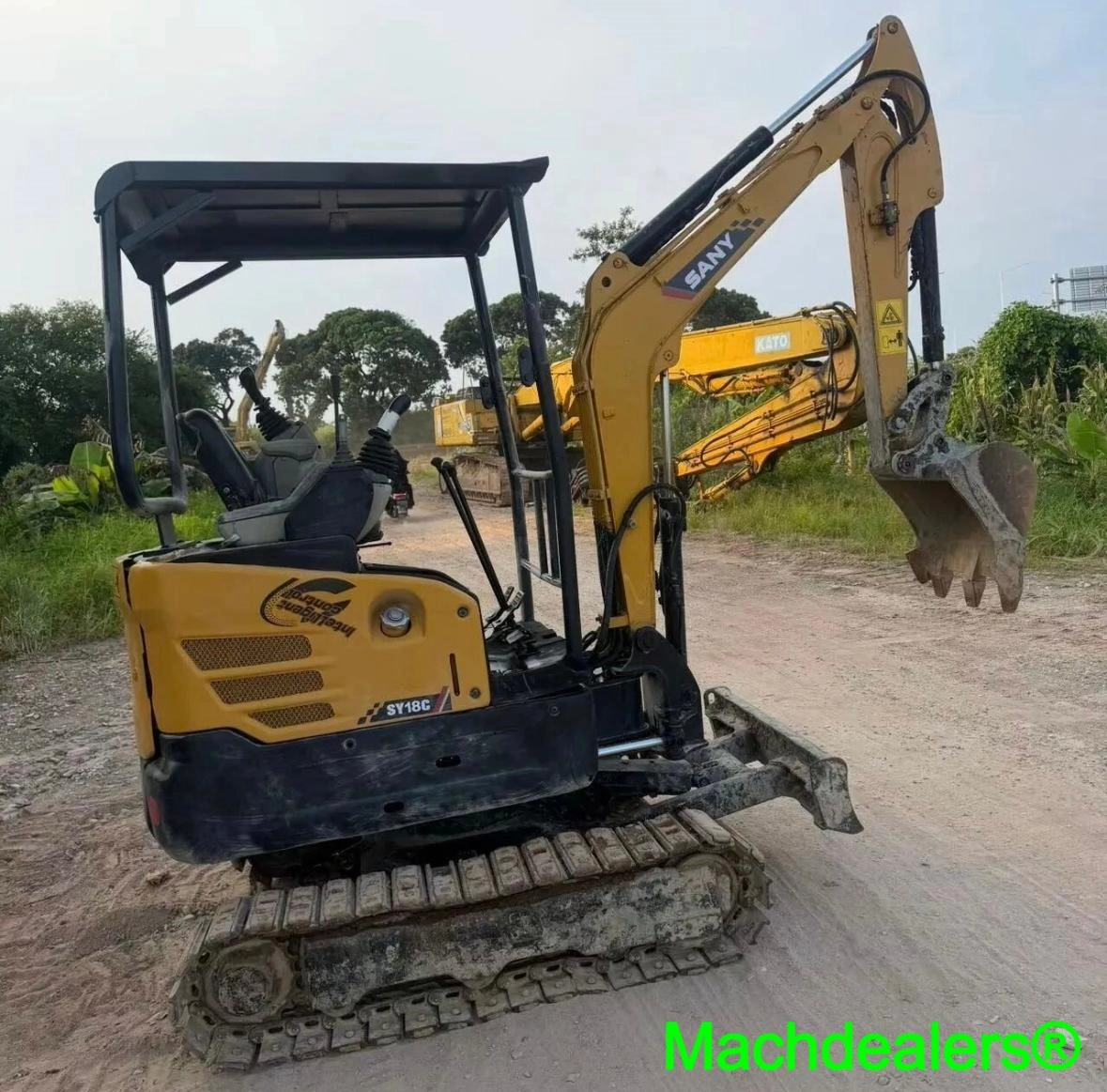

Hitachi ZX vs. ZAXIS vs. ZX200 Naming Variants — Catalog Trap for Used 20-Tonne Buyers
Simple. Brutal. The badge is more of a marketing thing and you’re looking to purchase a hydraulic system.
In the past 30 years or so I have had the opportunity of working with perhaps 400 of these 20 tonne machines and if they had ever broken down, they had never caused pain. It’s the ones that bolt up that are the ones.
There is a naming history, but it’s not a history. It’s a hazard map.
At the bench they told me this. Comparing the two valves on a steel table, I placed the old valve and the new valve side by side, and crossed them with a straight edge, across the spool bores. The new casting sat a few millimetres high than the original casting due to the pilot circuit being modified from a mechanical linking and cable type circuit to a proportional solenoid type circuit, which required the geometry of the spool in the casting to be modified. Same nominal bore. Same port spacing. There’s some differences in travel of the spools, and a different metering profile on the lands.
So it would be concluded that the machine started. Candidly, this is the harsh aspect, it would have started up, idled the boom and the operator would’ve found a bit of a sting in the combination’s motion and cursed the pump. The oil recommended for the spool lands didn’t occur on the old regulator so the valve would have been lazy in one direction and grabby in the other. You would pursue that for a week! New pump. New filters. New relief settings. All of it wrong.
What’s more challenging is the covering electronics. The controller on the earlier amperage generation valve body doesn’t recognise a sensor package and a solenoid driver harness that the later-generation valve body has. No fault code. An uncontrolled input, like a letter sent to a place where there’s no one anymore and which just lands in the controller, without any outcome.
I’ve seen it backround too. We have a buyer who removed a pump off a Tier 3 machine and attempted to fit it into an interim Tier 4 chassis where both both the Tier 3 and Tier 4 were the subject of a “ZX200” title in the same marketplace feed. The flange of the pump is matched. This is because the displacement signal the pump would send to the ECU fell outside of a new calibrated zone (faults) as soon as the engine was out of idle. For one month the customer was convinced that he had purchased a faulty pump. He’d been purchasing a pump for a different machine that had the same name.
I am not going to give you a table of part numbers; a number I remember from a parts book in one market and in one production window will not be right in other markets and production windows and a wrong number is worse than no number. What I will tell you is the form of the divergence which holds.
So: a pump from an earlier family will physically flange (most of this ones I’ve done) to a later chassis, it’ll build pressure and it’ll regulate against the wrong pressure. On the gauge, it appears as the needle that hunts: the slow moving increment around the set point (operating set point) that occurs, but is not noticed by the operator and is causing reading of the pressure at that instant to be off. After spending an afternoon in the world with a flow meter and a clipboard, one could envision the number a few bar of wander as a fingerprint, a first time user could only imagine it as noise.
The other side is worse consisting of the ECU, because it is not seen. Each generation’s firmware revision alters band which the displacement feedback of the pump is supposed to fall within. Perform one of the following: Place your properly named pump on a properly named machine, having the improper firmware installed and you have your no-explain limp mode! The controller does not require replacing. You’re being misled by a falsely reading sensor!
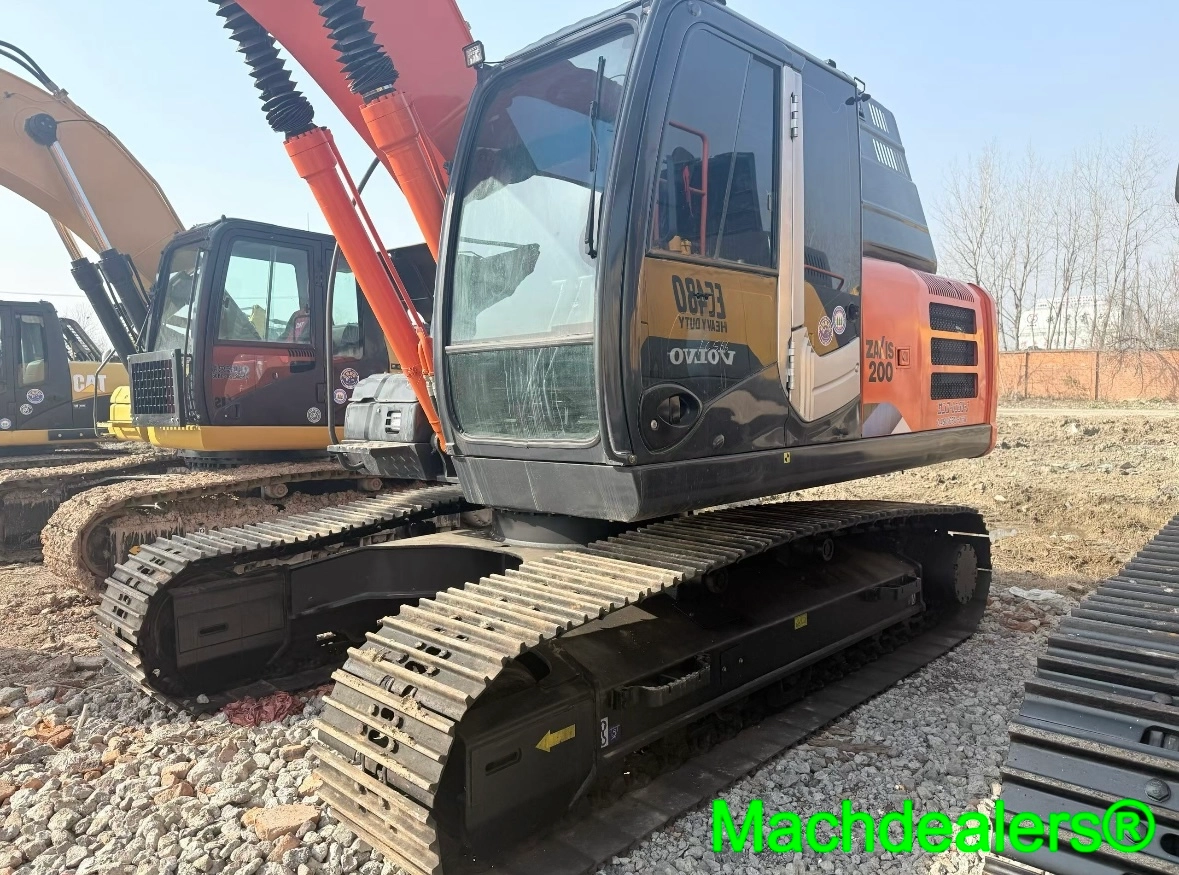
The aftertreatment theme of these vehicles follows a combustion management theme up to Tier 3, with the engine told to do something different and modifications to hardware bolted around the engine being modest. Tier 4 interim drags the DPF and oxidation catalyst, as well as the dosing system and the forest of sensors that it all entails—and all of those items involve wiring. The harness grows. There are more connectors on the cab junction box. The cooling pack gets bigger, as DPF regenerations will deposit the heat within the system that has been dimensioned for a non-DPF machine.
This is the mechanism which is lost on people. When one of this things occurs (eg a ‘regeneration’) the temperature of the exhaust rises significantly and the ECU then takes measures to increase or decrease the load on the engine, and options available to the owner may based on the vehicle’s configuration include altering the fan drive performance. This means that the fan clutch and the radiator core thickness also move with the aftertreatment decision, and simply don’t fit into a DPF chassis even though mounting ears may match with a previous machine that did not have the DPF. It’ll fit. It will be overheating one hot afternoon under load and the operator will be complaining that the machine “just gets tired” – that’s the least helpful of all diagnosis.
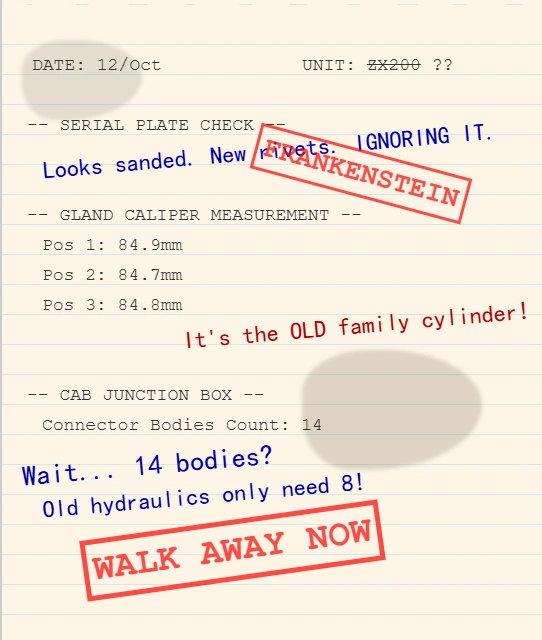
I don’t go in order of the serial plate. They are replaced and then sanded, repainted and sometimes put back on the machine by a man with a rivet gun and a real big bribe if the machine has been used by a hire company! I begin my assault with some calipers in my tense right hand and oil from the machine that is in my left forearm, having approached too near once again.
The top and most truthful indicator that I know is the rod diameter at the gland. Slide the caliper across the chrome at the point where the rod comes out of the gland, measure three times around the gland to get ovality and record the measurement. The separation of these two families of hydraulic machines is not complicated and it’s not delicate: It is what happens when you write a number in your notebook that puts the machine in one family or the other, and it does so without asking the seller, “which family do you want it to be in? To a first home buyer that’s a number. I think that to me it is a birth certificate.
Then the harness. Open up the cab junction box and photograph, or have seller photograph, box with coin for size, and count connector bodies. Not wires—bodies. None of the other circuits (pilot circuit, aftertreatment sensors, and telematics module) arrive as single wires in the loom; each one introduces its own branch into the loom, and the count gets larger as the generation count increases. When it comes to re-built cabs, a cab with more counts installed on a cab with older hydraulics is either a re-built cab, a re-power, or a relabelled re-built cab, and any of the three are issues that you don’t want to discuss after money has left your hand.
Data sources for the table above:https://www.rbauction.com/pdp/2022-jcb-131x-l-4f-tracked-excavator/16054805
I’ve seen a man install a reconditioned valve (that is fitted with the original End-cap Seals) chase an external weep for three days, reinstall a valve at his own expense only to find it when it returned bench-tested clean. This leak was not a leak in the valve. It was a ring that cost $2, but had differing memory shapes. In his case the weep was so slow that it never moved to the floor—it merely misted onto the hot casting and baked into a coat of varnish film which he assumed to be a manufacturing defect with the new part.
The other part of that lesson is grease. If a machine has been sitting and a pilot port O-ring has been dry fited, it will have a shaved lip on the chamfer which will migrate. I have removed shivers from bore holes in the spools. They are relatively small, black and they present exactly the same symptoms as a solenoid failure–a stick slip in the spool.
The listing which provides a tonnage class without specifying an emission tier, nor using the frame serial prefix, and has four views of the machine with photographs showing the machine in a way that avoids the boom cylinder gland is a walk. Not because of the fault in the machine. Either the Seller doesn’t know which information he is selling and therefore can’t have kept it in proper working order or he is selling what he knows and that’s worse.
The one that has everything in check, and the machine is merely the old generation that’s listed as the better generation pricetag: that, better call an opportunity a disappointment. My reading of the used marketplace is that the mechanically operated “mechanical pilot” system on an early-tier machine is the better machine to own for an operator willing to perform his own maintenance: The problem states are physical and the incidence of failure can be detected by ear. It is possible to hear a cable binding. No audio output will result if there is a mismatch with both firmware numbers.
I’m just going to lay it out there. A verified spec sheet will not reveal information about how a machine was when it was first started, or whether or not whether a pilot fitting was lubed at the proper time or on the next machine the operator had occasion to use it. There is nothing on paper which does that. But it will tell you what sort of hydraulic family you are in front of and one answer can mean the difference between a part order coming in next month that bolts on and communicates with the controller and sitting in a parts bin with a connector that doesn’t fit.
The names will continue to be linked together in the catalog. Your notebook won’t.