
Hour Meter vs. ECU Stored Hours: Verification Gate for Hitachi Excavator Grey Imports
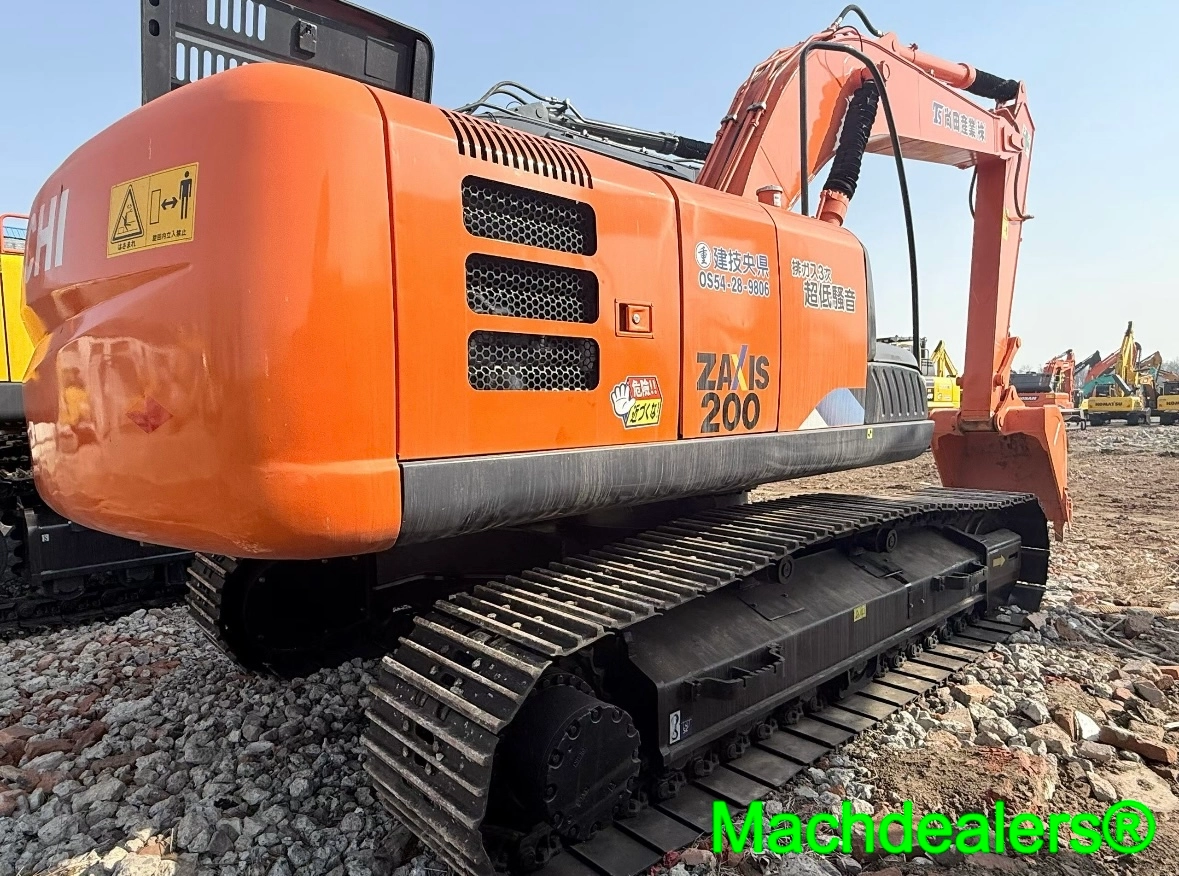
The ZX200-3 was removed from the container at 6842 hrs COD. Laptop that was plugged into a diagnostic port reported 6,844. Two-hour gap. That tie-up would give most shoppers some peace of mind. I said to the client go for a walk. That afternoon, the deal was called off.
It was not a lack of agreement, it was an agreement. When the machine arrived, it was a nine-year-old animal that had travelled over two borders and had probably been owned at least three times before, according to the records (if there were any). Years and years of logged time are seldom observed on machines that old. There is no law in nature that suggests this will happen. Components age differently.
The mechanical hour meter in the dashboard is driven by a cable that’s driven off the hydraulic pump or a stepper motor that’s driven by the ECU. The ECU keeps count of the operating hours in non-volatile memory, separate from that display. They drift. With a few years and a few heat cycles sufficient effect of the drift becomes evident. We do not assume that a lot of TABs have been honest in reviewing a high-hour unit and seen the same figures; we presume first of all that there has been some amount of intervention.
There was one thing the seller likely wouldn’t think to look at that took down the deal. As soon as I started to ask him to give me a close look of the instruments before I even got her running. Four Phillips-head screws cover the bezel; marks were present on the screws though the bezel was not removed. Fresh ones. The paint of the area around the screw heads was intact but the black oxide of the screw slots was scratched silver. The place had obviously been recently used. This could have been due to a bulb replacement. May have been a working afternoon job rollback with a drill and patience. The seller’s answer was that they had done a burned out backlight replacement. I requested for the previous bulb. They couldn’t find it!
Third reading: All calculations and tables have been performed correctly.
This involves a laptop, the appropriate scan software (Dr.ZX or similar third party software) and knowledge about which controller to interrogate. For ZX series machines, it is possible for several controllers to log hours, such as the engine ECU, controller and monitor controller. They should be relatively in close proximity. If possible pull all of them. I’ve seen efforts to replace the dash only, and the monitor controller and leave the ECU in the engine as is, figuring buyers wouldn’t skim both. The original hours were still on the engine ECU at 18,000 hrs. The monitor claimed 4,200. Instant walk.
Access to the port and the Generation Split are currently a work-in-progress.
Different standards of diagnostic port are used in Hitachi ZAXIS and ZX model years and generations. The round connector of an older ZAXIS-1 or early ZAXIS-3 is often located underneath the cab with most models on the right side near the battery box but in the access panel behind the driver’s seat. The units moved to ZX-series units with a standard large format rechtekt connector, sometimes accompanied by a rubber weather cap, which can be lost or left on top of a short tether. They are mounted in a variety of locations, with some being located under the front hood panel near the ECU in the engine and others installed under the cab. You have to (literally) check where it resides before coming to check it.
Pinout differences matter.
The 6-pin ZAXIS connector usually carries key switched power, auxiliary line(s) (configuration dependent) and CAN high, CAN low and ground lines. The rectangular ZX connector offers greater protection and redundance and in some cases it incorporates a second K-line to support older protocol use. If you’re using a universal OBD2 to CAN adaptor without knowing (or being aware of) the pinout you can back-feed power into the data line, and cause the controller to go into protect mode. I’ve seen one buyer lock himself out of an ECU that’s doing just that! Machine was towed to a dealer to do a hard reset. Deal died.
The other thing that use foots to get people: on/off (key-on) vs. running states.
There are ECUs which will wake up as soon as battery power is connected to the port. There are others that do need the key restart position, but with no engine movement. A few — usually ones with CAN-based monitor controllers — will not react until after the engine has been started and oil pressure is known: the main controller doesn’t fully wake up until it receives this information. If you do connect, no results and if you think that the Ecu is dead, you may be wrong. Alternate key-on with no start. Attempt to start-up and idle it. Move the connector around—On machines that have been used for some time in humid areas or near salt water the connector pins may be corroded.
Dead ports are a great red flag, but not the end of the world.
The problem can also be with the connector itself, such as it may be damaged or corroded enough that continuity has been lost. Occasionally an aftertreatment system will have had an aftermarket monitor installed, and the harness may also have been incorrectly spliced, resulting in the break in diag circuit. Fuses can be blown sometimes. It is a matter to play out the question as to whether or not the seller can clarify. Shrug and say “It’s always been like that”, assume the worst—was the port disabled on purpose or have the controller changed somehow and no one wanted you checking.
Serial-number traceability breaks.
Each of the major parts of every Hitachi machine is normally marked with a serial number. Engine, Pump, Swingmotor gearboxes, motor travel gearboxes, boom cylinders, control valves. But as long as I am able to find those serials on factory build records and/or dealer service records, and it all makes sense to me. If one or all of those numbers don’t correspond to a number in the system then I know a piece has been added from outside the system. That is not necessarily disqualifying, as that’s how this business is being done, but it is a confidence loss. It should be able to be explained by the seller. In 2019 we replaced the swing motor with a rebulit one in the industry, here is the invoice.”Fine. I don’t know, I think it was just like that when we received it. Not fine.
With every missing document, there is a loss of verification confidence. There is one thing that is missing, you can compensate for it. Two, you begin to see whether you can obtain a lower price. Three or more is an unproven machine that you are buying with not one bit of data that can help forecast when the machine is going to fault next, because they haven’t had one already.
No traceability on serial numbers of major parts.
If I don’t have proof of the match between the engine (and any other major piece of serialised equipment) and the machine’s build record and service history, I’m purchasing a “Machine” that has been constructed from unknown parts. If it’s a non-traceable machine, with prices listed as if it was, I’m not happy about that, no. However, If the machine the seller has the desire to sell at near market, it does not have any holes for component traceability, then the answer is no.
Failure to keep paper on a unit that is sufficiently old for it to have paper.
If the machine is three years old, and there has never been any service records, this is unusual but understandable – some small contractors don’t keep good track. If it is 10 years old and there are no records then the odds of it being properly maintained are close to nothing. Walk.
These aren’t places to negotiate. They’re gates. When I determine a machine has passed one, it’s all over the talk. Cost Difference is too great. The impact a mis-verified import has on your Operation is NOT linear. It’s not only the money lost when buying it. It’s the amount of time you invest while troubleshooting the problem prior to knowing what broke. The parts you buy are those that are not exactly the correct fixes, when you didn’t know the true failure history. That is the maintenance plan you had around false hours, and thus under or over servicing your vehicle. And on the resale value, that you’ll never recover is when the next buyer does the verification work that you didn’t. I will pay my way back home before I will pay for that.
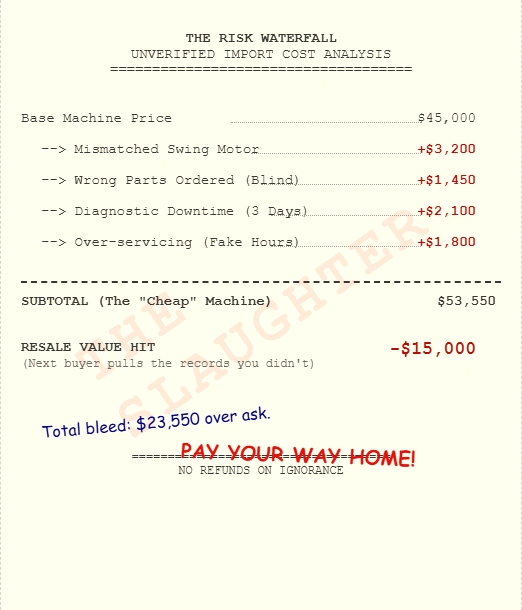
Data sources for the table above:https://eu.ironplanet.com/ironclad-assurance
You have become adept with the interrogation technique. You are familiar with gap patterns and their significance. You know your records; what you’re missing and by how much. What is important now is semantic resolution the standards to machines that have already been verified. Obtain quotes for reported used Hitachi excavators that are in serial traceability, d2eagreement, and which have been service throughout. Search Hitachi listings for brand, model and year, to ensure that the generation and specification you are looking for is on the market. That isn’t “risk free”—all used machines come with a certain degree of risk. It’s removing a known danger!