
Undercarriage Cost Reality for Hitachi ZX200-Class: Measuring Remaining Life Before You Wire Deposit
The problem for the Hitachi class ZX200 is undercarriage cost reality, that means measured in a way to determine life expectancy prior to wiring deposit.
Using a screwdriver that I removed from my vest I inserted the tip between the track pin and bushing of the fourth link. Usually there is some resistance, perhaps a 1/4”of metal, and the end doesn’t go any farther. This one made it almost halfway down the pin and I could hear the slight scrunch as it was going through a hole that shouldn’t have been there. Even simple arithmetic will put that chain past 2 percent pitch elongation likely closer to 2.4. The chain was now over extended and tearing out the pins from the bushings like some sort of awful orthodontic treatment. This cannot be determined from hour meters. Only your hands do.
That Reno machine. Sixty-eight thousands, that was what the seller wanted. I quoted him chains, rollers, idlers and sprockets at eighteen nineteen per good aftermarket – twenty four twenty six if he wasn’t sure the only sure thing was OEM – plus (roughly) a week of downtime plus a week of shop labour. I walked. Twenty-four months later he wrote inquiring if the number 54 would be of interest. It did not. I heard that a month later it was sold at auction and failed to pass the fiftieth bid. Somebody else took the ghost cost stroke of which I had already given an estimate.
This test is for a person’s hands and tape measure prior to going under the wire.
Understanding the extension of the TRACK CHAIN (The 2% Rule).
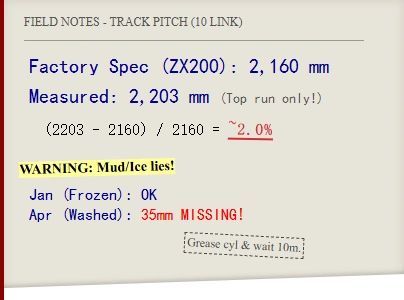
Ignore the one’s that are connected individually. At least 10 pitches of space is needed, since shorter will allow your error margin to be amplified to an unusable level. 216 millimetres per link is the factory pitch for ZX200 and ZX240 and 10 links, when new, are 2,160 millimetres in length. I have a butted plain tape which is long enough to hold flat made of steel, and I suspend it between the middle of the first pin and down the middle of the tenth pin. Go for top runs not bottom. The bottom run is below the machine’s weight, and will make you feel good and pay for it.
The next link on the ten link version reads 2,203, so there is 43 millimetres of stretch. Divide by 2,160, times by a hundred, now you’re at about 2 percent! The edge is two per cent. While it is simply the replacement threshold mentioned in Hitachi’s manuals, here’s what the manual will not voice–that number is for average conditions and disciplined maintenance. For demo I have seen people calling a Chain dead at 1.5% but they know once a geometry collapse is in process load spikes will accelerate it. So, on soft ground earthmoving in mild climate you would think you could push 2.3 and get away with it. That figure of 2.3 on a clip board is a pretty uninteresting number. To me it is a “count down timer” with the numbers removed.
The “classic” fault is the wrong way of measuring. If the mud has been caked over or the ground frozen over, your chain lies about its tightness. One time I saw a buyer do this, measure a ZAXIS 200 in January and get a borderable number and purchase a quantity and then remeasure the same one after a steam wash in April and find that he didn’t have anything for thirty-five millimetres. It’s also skewed if there’s pre-tension. Slack tracks for power-saving results leave the chain with a bed of an elongated relaxing position even when it’s not on the ground. Tighten to spec using grease cylinder, wait 10 minutes and check. I have seen someone save 15 millimetres on a terribly ugly number—that’s as opposed to walking away totally.
Data sources for the table above:https://www.cat.com/en_US/blog/planned-maintenance-cat-dozer-1000-hours.html
New link profile: Dash-3s and after feature a link design that is a bit less stretchy than the Dash-1 and Dash-2. In my hand it equals just about 200 hours en-route margin. Not that a miracle, simply margin. ZAXIS 200 is the very same system offered in a market dependent badge. Then it’s not the case for ZAXIS 210W (the wheeled variant) so don’t get caught by a seller in a tracked-under carriage discussion at a fleet sale!
Sprockets wear top-down. The teeth produced in the factory are utilitarian, that is, they are sharp and do not have a defined peak and they are not clean, I certainly wouldn’t want to hold on to it tightly. The peaks of the bushings are ground to rounded nubs, and eventually hooked back when they are under load. At the hook position the chain begins to rise from under under high torque, particularly in reverse, with a metallic sound as a chain moves across plate steel.
This is the subtlety you should put in your time. Behind the new torque curve, the final drive of the Dash-3 models had been revamped; the hydraulic motor’s output was also sweaked around to reduce the throttle-on-understeer shock load when turning. The wear appears to remain about the same speed as far as I have seen, but it’s more uniform mayhaps within the width of the tooth. The tendency is for a circle to be formed along the outside one-third due to uneven torque delivery by the old drive; that circle will become a stress concentrator and I have seen teeth cracking and fracture there, making it a wear item, again. There is no such thing as time-limited revised drive. If any one is telling you they have “dash-3” so the sprockets can last then that’s the feeling they are giving you, not a measurement.
I think there is one guy near Bakersfield that bought a used 240 with brand-new paint on the track just because the colour of the paint on the track matched the colour of his welding truck. Same colour. Sure, that was it for technical due diligence. Eight months later he phoned me about the idler that seized, and a quote he didn’t care for.
Two failure modes for roller and idlers: Shell thickness and Seal weep. Shell first. The new one has a distinctively topped shape and a centre diameter that is slightly bigger than on the sides, ensuring a good load distribution and reducing side thrust. Wear turns that top into a curly center—one that has a concaved center. I don’t do this in the field: just crouch down, sight along the rollers on the side of the machine and see if light can be seen under the track in the centre. Shell ‘s done if I see gap.
It’s the seal that makes me obsessive, it’s the thing I can see easiest and the thing I can’t afford to walk away from. A double seal lip with grease in and grit out is located in each roller. Spring tension weakens as hot/cold cycles occur, abrasive dust and the lip no longer wipes and a light debris layer of dirt and grease accumulates around the end cap. This is ignored by everyone as it’s still able to roll freely. It as a result of the roller spinning isn’t the diagnosis. The diagnostic is that as soon as the lip wears off of wiping, the contamination moves into the bearing, and a contaminated bearing is smooth to notchy, hot and then more contamination, and so forth, ending up with a locked roller and gouged track link. So I have pulled rollers that had’weep up’ for a season and the grease inside has turned to a black peanut butter substance, it is no longer lubricant but is metallic paste, because the sealing lip, not the reservoir is worn.
Now you know how to measure, apply this knowledge to inventory!

You’ve got the protocol. You know what 2 percent feels like under a steel tape, how a sprocket is supposed to feel from the top to the hook, how a weeping seal is leverage—even though the roller is still turning! But the other half of the equation is that it’s against equipment that hasn’t been spiffed up to be quickly toppled over.
When considering the choice of variables on the underside, first filter out the candidates in the twenty-tonne class (ZX200, ZX240, ZAXIS 200 etc) that fall within your budget ceiling and then start tinkering with the undercarriage. Use listed hours and price range to create a short list, and once you have listed the hours and price range; compare asking prices on the Hitachis inventory listed by multiple sellers to determine your baseline.
It’s not the machines that have already been manipulated in this manner that will be the ones worth your time. Begin searching with the filters and focus in, then check the steel.