
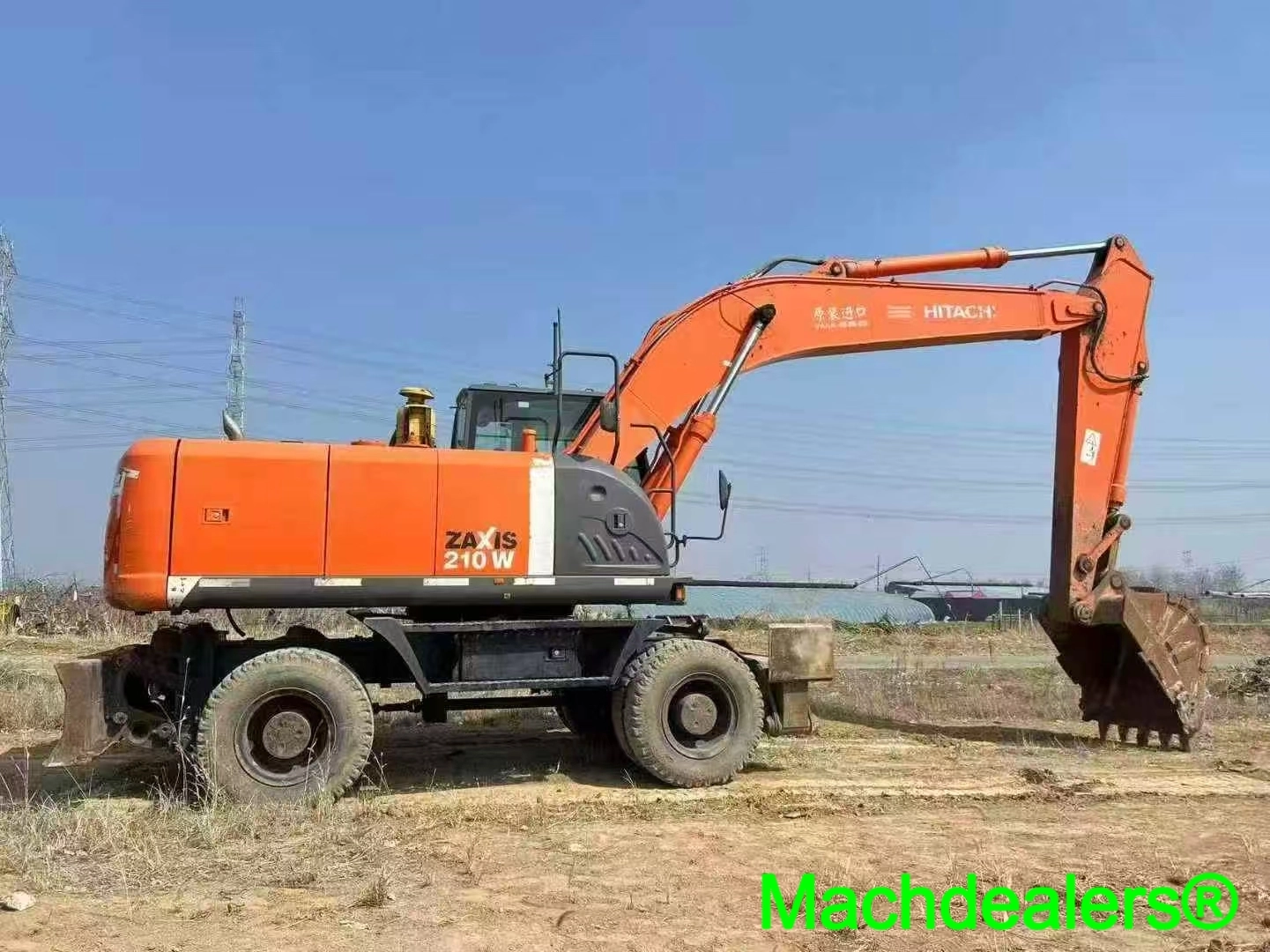
Wheeled vs. Tracked Hitachi 210-Class: Why ZAXIS 210W Requires a Separate Buyer Sheet
This just brings to mind one of the most bizarre instances of an “excessive track sag” being noted by a surveyor on a wheeled machine–he had either taken his eyes off the bulge on the sidewall at that time or had no idea what measurement protocol to apply. I don’t recall laughing at the moment. I should have.
What really ticked me off about this category of procurement-tease is this. It isn’t ignorance. Typically, the parties will be familiar with excavators. For years they’ve purchased tracked 20 tonne machines, they have knowledge of hydraulic systems and they know how to read a swing-bearing backlash measurement. It is a fact that’s ability is real. The problem is they don’t account for what can be confidently done in one configuration being automatically portable to others.
It doesn’t.
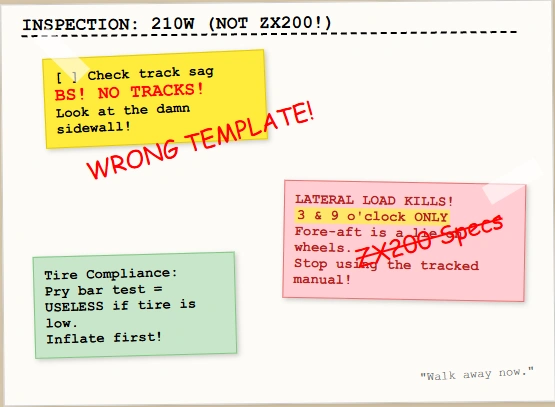
Take swing-bearing backlash. On a tracked ZX200, you install a dial indicator on the inside racings of the ZX200 and rock the upper structure and read the dial indicator as per your OEM tolerance band. Clean procedure. However, on the 210W road-transit vibration harmonics cause asymmetric loading of the bearing. I have seen fretting corrosion on 3 o’clock and 9 o’clock positions (lateral load axis) and the fore-aft quadrants were barely used on a wheeled machine. If you are performing a backlash check for a tracked machine, and are using a failure map for it, then you may have cleared the backlash axis you are checking, and totally overlooked the backlash axis that really matters.
Data sources for the table above:https://www.machinerytrader.com/listings/for-sale/hitachi/excavators/1031
Sadder but truer, often the OEM service documentation is not of assistance here. Under the 210-class umbrella Hitachi issues service bulletins, and a tech not specifically searching for a configuration split may take the torque spec of the tracked machine for swing-bearing fasteners and apply them to a wheeled machine, unaware that there is a differing torque spec to take into consideration that road-vibration fatigue would require for the wheeled machine. It’s not a huge gap in numbers. However, cribbed together fastener relaxation occurs over 18 months on the highway and occurs on each service interval.
Now—the matter of wheel-bearing end-play that they have on the 210W front steer axle needs some special consideration.
Correct field technique: block the tire, set up a known dial indicator on the hub face, apply a known lateral load by using a pry bar, take a reading on the dial indicator. Maneuverable with a deceitful sensitivity. What the problem is, is that there’s added compliance due to the tire. A worn or under inflated tire take up some pry bar input before it gets to the bearing. I have taken readings from this and a clean reading was given, thought that something must be wrong, inflated both front tyres again, checked again. The number moved. With under-inflation showing up in the side, the reading was only marginal. This is not in any tracked machine inspection protocol as on tracked machine the final drive housing is rigid steel. No rubber between your measurement and your indicator, which conforms to it.
It’s a pretty significant little modification. It is a new construction inspection paradigm.
Duty-Cycle Physics: How Road Registration Rewrites failure map.
There’s no comparison between the failure topology of tracked and wheeled 210-class machines. The high-probability failure zones I observe on a tracked ZX200 or ZX240 are: the weeping hydraulic motor shaft seal in the travel motor output, the pocket from abrasive contamination in a travel motor grease-nipple wiper seal and idler-bushing radial play from slipped grease intervals. Jobsite failures. Abrasion, cyclic hydraulic pressure and contamination from the ground level. It is never moved faster than at a brisk walk.
All of this failure topology changes on the 210W.
There isn’t one that buyers don’t underestimate, except for the tire’s sidewall heat-checking. With wheeled excavators, regular road transportation builds up heat cycling and there is no tracked-machine equivalent. The sidewall will flex on the highway, build up heat between the plies, and if operating at “full throttle” or with only slightly depressed pressure level, the radial plies will start to separate around the circumference, on a microscopic level, before surface cracking is visible. On each and every 210W pre-purchase inspection I rifle my thumbnail into the sidewall rubber next to the rim bead. I’m looking for the softness, or the feel of more dry clay than live rubber. There is a certain “thumbnail” resilience that new tire compound exhibits, one which is not so easy to put into words but is easy to recognize if held in one’s hands. Sidewall will feel dead when fatigued due to heat. There is not a complete rebound in pressure.
Does not test with a tread-depth gauge. None I’ve seen any associated checklist.
The transmission is the part that’s more difficult. The road transmission of the 210W machine does not have any synchronizer cone assemblies that are not found in the travel circuit of the tracked machine. With tracked excavators you’ll have hydrostatic travel drives and the hydraulic motor through the tracks goes out the track speed goes up with no gear-clash possible. During the shift of wheels, the speed in the shafts must be equal through the different gear ratios; if the operator is a hard shifter, there will be “bronze synchronizer cone scoring. The wear products are fine, metallic and deposit in the transmission oil giving a copper/bronze shimmer when the oil is drained on a white cloth. I always search for this colour. On a pre-purchase inspection most don’t check the transmission fluid at all. They look at a dipstick, and record the level, and then get on with their task.
Different situations can arise regarding cars that are “On-Road Homologated” and have maintenance manuals that differ from the VIN.
The brake system certifications found on a homologated 210W indicate hydraulic brake performance requirements, brakefluid hygroscopicity change periods and axle-load related statements based on the export market. These documents have a totally different filing category from regular OEM hydraulic record keeping. They are issued by a regulatory body, not by Hitachi service departments and have an expiration date.
I have witnessed transactions, not because there is something wrong with the machine, but because the machine is not operated on the road and the buyer insurance underwriter demanded that the machine have current brake certification documents. This will never occur when the machine has tracks. A ZX240 will not be asked for its brake certificate.
A parallel is the axle oil examination record. All tracked machines have hydraulic oil sampling records. On a 210W, the axle differential should have its own history of an oil analysis–metal particle counts, viscosity trending, water content, etc., showing the road duty thermal cycle. As far as I know, this is the case only half of the times on a used 210W. Sellers that had utilized the machine largely at the site didn’t bother. Depending on the extent of operation of the road-based repositioner, a seller may have a history if their maintenance company was a disciplined one and would maintain it on a regular basis or may not have one of it was a “change it when it looks dark” kind of company.
If no records can be found, it’s back to the real world evidence.
Non-Transferability of components–Three checkpoints
Checkpoint Alpha—The Depth Mic That Lies to You
The height of the teeth of a tracked drive sprocket is measured with a Mitutoyo depth micrometer. Repeatable measurement, well documented wear limit and clear remaining life indicator.
However, that instrument is not available for application in a wheeled 210W. Zero. Tire Deflection Check and Tread Depth Check are in its place. For wheel end bearing play, it is replaced by a dial indicator that is documented with a pry bar load on it. Different tools. Different reference values. A variety of failure modes that are being interrogated. Inspection reports from tracked-machine templates appear on the used-machinery market more regularly than the industry divulges, since the inspections are done by an inspection contractor on a standardized inspection form and there is no request at the buyer’s end for a wheeled configuration form.
Checkpoint Bravo—Swing-Bearing Bolt Fatigue at Wrong Clock Position
Road transits vibration on a wheeled excavator is primarily in the lateral (crosswind load/road camber/braking) direction and is transmitted to the upper structure via slewing ring. The inner race is subjected to cyclic lateral bending load from the bolts which attach the inner race to the carbody, no equivalent load exist in tracked-machines. The mode of failure for the fatigue comes as fretting at the bolt-hole interface along the lateral axis. In severe cases, micro-cracking will be present at the thread runout and it can only be seen through the use of magnification. These bolts can always be cleared upon a visual check from standing height. Micro-movement is indicated by the rust bleed from the bolt head and requires a flashlight, a mirror, and up close and personal near the bolt head to see.
But on a tracked machine, I am concerned about other signatures like the impact damage of thrown debris and fastener relaxation at the torque frequency of the travel-motor. An examination with no relation to the one before.
Change the oil and celebrate at Checkpoint Charlie!
A 210W differential on the axle should be filled with GL-5 2X SKINPAC Lube Oil (limited-slip) that contains friction modifier. If the trucks have tracked final drives, use ISO VG 220 EP gear oil in them. These can’t be swapped for one another. The EP additive chemistry of ISO VG 220 will attack copper alloy parts–the very parts that make up a limited slip differential’s clutch pack. A failure sequence in slow motion, as the result of cross-contamination from a common bulk-oil drum. Friction modifier wears out. Limited-slip operation deteriorates. Slip starts with hard pulls or tight radius turns on clutch packs.
This failure is not accompanied with a noisy or an obvious leakage. It creeps in, over a period of time. The only way to pick up on the problem early is through behavior: slight body movement of the machine when executing a sharp turn at peak load. Most operators would attribute that to the force they’re putting into their tires or surface conditions and make adjustments in techniques.
Proper prevention efforts include fluid storage-room labeling, maintenance cards specific to the configuration being used which are physically attached to the machine, and the oil analysis program that provides detection of GL-5/EP contamination before it can affect the clutch pack.