

CAT 305.5E and 305.5E2 Dealer-Channel ECU Records: What to Request, What It Proves, and What It Doesn’t
My 305.5E2 was sitting in a gravel yard outside of San Antonio with 1847 hours on its LCD, and a binder in the cab that would put tears in the eyes of a bank auditor. All the services were available: 500-hour, 1000-hour and even a 250-hour break-in that most owners would overlook. Stamped. Signed. Photocopied. The number, 1847 hours, was clean to a first time watch buyer, and was more like a copy shop smell for anyone who bought an auto before going to the gravel yard; I was clutching half a chicken and a sandwich while the salesman handed me the binder and I remember thinking it smelled like a copy shop, not like a machine that had been digging caliche all four summers in a 90°climate.
Most customers overlook this: They assume that a machine that’s gone through “unauthorized” reseller hands has maintenance, but they are wrong. It’s a proof of paperwork that can be re-entered, re-typed, re-stamped and re-sold.
Data sources for the table above:https://blog.rbauction.com/equipment-inspection-tips-skid-steer-loaders/
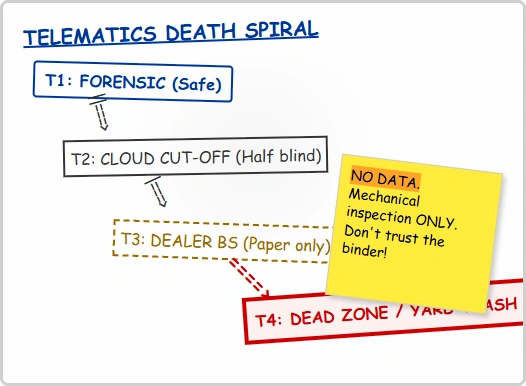
The Difference between Telematics Export and Re-entered Service Log:
It takes a trained eye just about 30 seconds to find a true telematics export. Timestamps are machine generated so that they form clusters at periods of time in line with the machine in use: 5 days of activity, 2 days off, a period of working during construction season, a period of dormancy during the winter. etc. and the fault codes can be timetabled in sub-second resolution, and related to specific operating conditions. High coolant temp when load is on at 1,847 RPM. More than just “high coolant temp.
Pre- LOI Cross- Referencing ECU-Stored Runtime to Paper Records
First step is to take the ECU runtime via the service tool–not the dash display. The dash LCD is a stand alone module which can be replaced or re-flashed. The ECM runtime has been programmed to non-volatile memory and is much more difficult to change. Record the number. Take a picture of the screen, so that the serial number is in view.

Next inspect O-rings of hydraulic quick-disconnect couplers. This is the check which most buyers miss out, and which is a wrongdoing to do so. But a real low hour vehicle will have supple, slightly shiny looking and feeling O-rings with no sign of compression set. A machine with high hours and rolled back meter will have O-rings which are flattened on the sealing surface and have hardened to the consistency of plastic and fine radial cracking from year to year degradation of the plastic by thermal cycling. Once the hardening becomes familiar, the chemistry is obvious: nitrile seals draw in oxygen while in use at operating temperatures, the polymer chains cross-link, stiffen the seal and over thousands of hours of heat cycling, the plasticizer used to keep the seals flexible works its way out into the hydraulic fluid. This is a process which can’t be reversed or faked. Seemingly “1,800-hour” machines from which I have peeled O-rings which disintegrated between my fingers. That’s not an 1,800-hour O-ring. This is a 4000 hour O-ring, that was in the parts bin being battered around as someone was typing a new service log.