

SK55SR Ex-Rental Iron: Why Short-Radius Machines Wear Harder Than Their Meters Show
A mini excavator’s hour meter provides information on the number of engine revolutions multiplied by a time equivalent. Nothing else. Knows nothing if the operator is feathering his joystick while running at part throttle in a trench that is laying landscaping, or slamming the pedal through the floor and swing lever lock-to-lock in a trench that is digging a basement where every revolution is to the beat of a rental’s clock. Adds 1 hour to the meter. One is destroying components at approximately 1.5-2 times at the other rate. The meter gave no consideration to that.
To be honest this is not a fault with the design. The hour meter is designed for owner/operators using their machines at a reasonable rate and maintaining them every x hours. All that goes out the window as soon as the machine starts giving rental services.
What changes physically?
The swing motor is on an SK55SR. With owner-operated use, the operator swings, digs, swings back, dumps and comes back–quite possibly 4–6 complete cycles per minute, with a short pause to check on the cut. If the job requires the short radius machine to be used on a confined site, then that frequency may double/triple. Swing to cut, swing to load a truck sitting not very square, swing back immediately as foreman yelling at schedule… This is not uncommon—10-15 times a minute. All of these cycles fully take the swing motor through range, slam the brake and hammer the swing reduction gear.
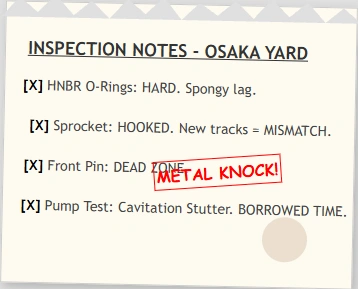
That heat has to go SOMEWHERE. First into the hydraulic oil. The SK55SR operates a fairly modest reservoir by the standard of this class machine and as a result has some fairly aggressive thermal cycling. If the oil is stored for long periods at high temperatures the following problems will occur: The oil will oxidize more quickly, the oil’s viscosity will begin to decrease and the oil will begin to attack the elastomer seals in the control valve stack. I removed the cover off the main control valve on one ex-rental ship, around 3000 displayed hours and two of the spool valves in it had got hardy. Not leaking yet. Hard. An HNBR O-ring will seal while in its rest state (a bench test will be passed), but can no longer keep a seal line when subjected to dynamic pressure spikes when the HNBR O-ring is unable to deform sufficiently. You receive a bypass surgery within the body. This machine is still functioning. However, it just feels gentler.
It is a softness that is the signature. When SK55SR is healthy and idle, it provides a clean and even engagement point between the Closed and Metering modes, as if the change were mechanical. You make motion on the lever – notice when a small amount of resistance building occurs – the machine responds. A machine with bypassing spool valves provides you with a “spongy lag—in effect, the joystick is connected to the hydraulics with a rubber band. Virtually all inspectors do not bother to look for this. They swap around every function, check whether it moves or not and continue to the next function. The machine passed. Good enough.

“It’s not good enough. This sponginess allows you to know that there is internal wear somewhere in the control valve that will result in loss of pressure and efficiency, and eventually a complete valve rebuild before the hour meter indicates.
The magic multiplier number is indeed 1.5 to 2. This is based on my experience with about 20 ex-rental units that were sold as SK55SR, where I did a comparison of component wear on the units sold by owners (e.g. displayed hours) versus rental machines. It still goes on: swing reduction backlash opens up earlier, track link elongation allows for greater pick-up speeds at the boom articulation and pin- and bushing-clears open up faster. The meter reading is 3000 hrs. The iron says 5,000. That’s where the game is during negotiation time.
What Your Hands and Ears Find The Seller’s Sheet Won’t Show
Crouching beside an SK55SR in a yard near Osaka, I’m eating half an egg-salad sandwich from a konbini down the road, while checking into an acerola. The car had just been pressure washed under and I should have known a car with an unwashed undercarriage would be a red flag as well. However, I was hungry so I did both eating and working with one hand.
I passed the sprocket tooth outline with my finger. The most informative Five seconds, on any used mini excavator. Low hrs sprocket has a well-defined and almost flattened working face and a slight curve at the tip which can be felt. What is certainly not wanted is a hook–that sole is shaped and pointed because you used it for hundreds of hours, and 1000’s of pulls. There’s a sprocket wear and it’s not Ditties and caterpillars!
That’s where purchasers go incorrect. A faulty hook doesn’t necessarily mean a bad sprocket. I have witnessed owner’s who have put in agents and machines with slightly hooked sprockets and still have 4000 hours and service life remaining. It’s the mix! If the hooked sprocket looks like it’s in good shape and the new-looking tracks are present, then get up and stroll. The geometry is quite hard-baked: a used sprocket and a new chain will show a different profile of the chain pitch—on a used sprocket, the link plate seats off center in the tooth valley and for every revolution, the grinding force that is being applied is not perpendicular to the link pin but on the sides, consuming the pins rather than on top. The new set you make will wear out sooner than the old set that was in line with the degraded profile.
Finally, after the sprocket-the pins. The SK55SR’s boom-to-arm front pin is the true tale teller. I lift the bucket, against a curb or corner of the transport trailer, and manoeuvre the arm slowly through the crowd. I’m looking for the “dead zone” that is the initial lever movement that won’t cause the boom to move. But on a tight machine it is hardly detectable. On this worn one–a beat of silence and then the boom swings when clearance closes.
The distinctive sound is equally important. When pressure is applied to the front pin, it will give a click, but not a knock if it is worn. Bold click, to the point sharp metallic noise as the pin passes whatever distance it needs to travel and then picks up the load, immediately on the starting end of the stroke. When you change the direction of the load with the unit, listen for it in this position, when the bushing is complete.
Then the pump. This is where I put the sandwiched place. When at full operating temperature (full–all functions at full throttle for a few minutes until oil is at operating, or working, temp) run the two function test–full swing & full boom lift, both at full flow.
Listen for sounds of noise under working loads. The SK55SR’s tandem gear pump has a nasal whine at rated pressure that is normal, steady and constant as long as the load is constant. What you don’t want is a stuttering sound (like the small wrench the person tapping the pump housing with) within that whine at once awhile. It is cavitation erosion of the teeth on the gears or, early bearing fatigue in the shaft supports. Whatever the pump is, there’s no question, it’s on borrowed time. Dealer will refer to as normal noise from pumps. With the combined load a healthy pump generates a continuous sound without a percussive element. This one does not.
Data sources for the table above:https://www.equipmentworld.com/tracking-undercarriage-wear-on-compact-excavators-is-a-must/
Rejection Checklist—Walk Before You Write a LOI
As I’m writing this I’m reminded of an exceedingly silly case from last spring, as all these points from this checklist get squeezed into one machine.
There is nothing as abstract as this. Each item on the checklist, such as the sprocket tooth profile, wiped fault archive or pump knock under combined load is a filter. A body that serves as a barrier between useful machines and useless ones, good buys and bad buys. The hard part is knowing what to look for! It’s the hard half that takes place where these filters took place prior to the machine getting to you.