

KX163-5 vs. SY55U Hour Verification: Which Diagnostic Ports Open and Which Don’t
Two machines giving the same answer in different currencies
The near direct read is: KX163-5
The KX163-5 will transfer the engine hours that you have stored on the ECU, not only from the display cluster, as on most that I have touched this is not just for the dealers. It’s load bearing, in that the cluster will be addressed separately for some builds. If the two numbers don’t match, then you have your answer even before your engine is even warm.
What is returned with the hours is the fault library, fault identification codes, fault flags and on many units a fault occurrence counter. The order in which you sequence is just as significant to buyers as they think! A machine that throws a hydraulic overheat code one time at 400 hours, but not again through 2,600 hours is a different machine than the one that throws the code at 1900, 2050 and 2200. You can store run time, it is a record. They can clear the record, but clearing one means it has to be done consciously and lends its own editing to the record.
The archive comes into its own with the occurrence counters. Fourteen low load auxiliary faults or log offs are on-limit NOISE for the machine of that vintage. Fourteen instances of fault “main pump pressure regulation” is not typical on anything that has supposedly “2,340 hours of gentle use”. To a trained eye it’s a warning sign as that number reads. Not a death sentence! A warning.
It’s good to have live parameters that come across as a by-product of that connection – such as coolant temperature vs. ambient, hydraulic oil temperature vs ambient and actual rail pressure versus commanded. The difference between hydraulic oil and ambient on a true low hour machine at an operating temp should follow the light duty thermal load curve. When I checked these two while they were running the yard was running hot – perhaps air temperature was around the tip-up side of what most would consider a ‘typical’ summer afternoon in most locations – and the oil temperature on the KX163-5’s were climbing at what seemed to be a rate proportional to the circuits loaded. It’s really just my opinion, and I’m stating that, There is nothing quite like 30 years of experience watching oil temp needles to establish the baseline and it can’t be faked.
The undocumented channel: SY55U
Cleanly describing the SY55U is more difficult as there is no cleanly description of it in the documentation. The standard service port return varies according to the tool at the end of the cable, the ECU firmware version as well as–quite honesty–the regional dealer if they have even updated the cable firmware library for this model. Reliably retrievable retrieval path to obtain live parameters from the system, such as current rail pressure, hydraulic temperature in real time, and fault flags. It is not history, it’s testimony. Testimony provides information on what the machine is doing now. It doesn’t give you any information about hour 800.

The more difficult aspect is that a “no fault” answer with this machine isn’t necessarily a “no fault” answer. An ECU which is unable to be read is not a clean ECU. A port that hasn’t made anything is not a port that has a clean bill! The whole problem lies with the seller, and “our tool would not connect that day” is not a response for someone trying to determine what may have transpired in between hour 600 and hour 2,180.
It’s a workaround with reading live behaviour as inference. Let three crowd and dump cycles occur without consulting a wiped archive, with an eye on the temperature gauge–that will tell you more about the efficiency of the pump and health of the circuit than anything else can. The rail pressure behaviour on a throttle snap is an indicator of the condition of the injectors. The lag in pump response is an indicator of pilot pressure health and if it’s lagging downstream it’s an indicator of the health of the proportional solenoids. Saccharin to the buyer who assumes that to be proof is falsification, and there’s no documentation to the end of the day.
The response of the buyer to the inquiry asking for the hours
Hours are not time. What you will get is accumulated thermal cycles + accumulated load cycles + accumulated events of contamination in the circuit + accumulated fatigue loading in the structural members. The number displayed is a lossy indication of all four. Trying to achieve two thousand hours of work in a road-base project in a moderate-climate environment exposes distinctive stress, while two thousand hours in the marginal treatment of a wet abrasive soil in a filtration project exposes other stress.
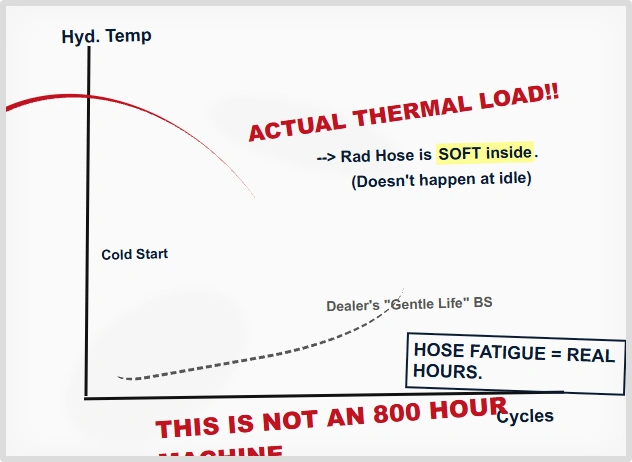
I went and picked up the KX163-5’s radiator cold hose off of the lower radiator connection. Machine had overhung the night before, at colds and the rubber was completely relaxed. Healthy hoses possess a give, which is the soft resistance of the hose that isn’t crimped when it is bent. It was a fit right for this one. Then I repeated the test after 20 minutes warm up on the SY55U, and the hose would not be described as being in a poor state for its age. Not collapsed. Not surface-cracked. The wall inside was just a little soft where heat cycles can only make it soft when it’s loaded into the system and goes through the cycles and not simply idled away in a gentle life. When a buyer hasn’t pumped in hundreds of hoses they cannot read that. It is a mark of an experienced hand that he or she cannot not read the cards.
Data sources for the table above:https://www.cat.com/en_US/blog/hydraulic-hoses-and-fittings.html
What remains after archiving a cleared forensics are physical. I read bolt heads. Witness marks are found on a fastener that has been off and back on the housing; the pattern of contacts of the fastener with the socket are offset from the original pattern seen on the fastener and/or the contact flats on the fastener may have a broken coating which doesn’t fit the corrosion age of the rest of the housing. When I got on the SY55U, I noticed there were 2 bolts on the main pump mounting flange which were marked for contact but not in contact with the adjacent flange surface. These bolts were missing at sometime. There was no information pertaining to the main pump in the archive. It seems odd that those two facts shouldn’t fit together.
There’s seal lip wear direction. The rod seal under normal service forms a compression ring that is symmetric along the lip of the rod seal. If one quadrangle of one of these lips is compressed to a different extent than the other quadrant, you can assume that the lip is run out-of-square and if you know you are doing it the way I do above, you will see the difference. That pattern isn’t something that you can just fake nor can it just be wiped out with a laptop. The machine is aware of what happened to it, either the ECU knows it or it doesn’t.