
Buying Used CAT Mini Excavators from International Listings: How to Use Year, Condition, and Hours Filters Without Getting Burned
For all intents and purposes, the ‘Country’ option on the vast majority of B2B listing website is all but ornamental. It does not indicate whether the machine had been used for 2,000 hours in digging in frozen ground in a Bavarian winter, where the impact to the bucket teeth and stick linkages was particularly high, or 2,000 hours in trenching in soft sedimentary ground in the Rhine valley where the impact was comparatively low, and therefore the wear on the bucket teeth and other attachment wear was minimal. There is no reference to the environment and surroundings. The listing displays a flag symbol, and refers to it as transparency.
By the term “fine dust” I refer to the 10-50 micron particles. The particle size is too small to be readily discerned but it is sufficiently large to be used as a lapping compound between the balls and the bearing races. As I removed the bearing races I noticed a texture (not smooth, but very lightly gritty) on the ball track surfaces. I used my fingernail on the race. That’s abrasive wear.
Operators begin to compensate by “overcompensating” with the stick inputs and thus increase the shock loads on the stick and boom cylinders. It cascades. If the bearing is 10% worn, there is extra wear on other components which would otherwise be fine, but downstream.
CAT has updated the undercarriage parts (the track link geometry, thickness of the rollers flanges and the method of hardening the tooth tips of the sprockets) from time to time, but without altering the model name or significant major news release. In high abrasion applications, the life of this change can be expected to give a maximum increase in wear life of 15-20%.
When purchasing used and filtering out to model and year range, there is no indication as to which version of the undercarriage is being purchased until the serial number prefix is looked up and cross referenced with the CAT undercarriage parts evolution database. Most buyers don’t. When they read “305.5E2” they believe that parts and wear would be the same all through the production. They’re not.
Layer 2 – Cross reference Behavioral Signals outside the Filter UI
The filter UI provides you with structured data, year, hours, price and condition. However, the signals you can get from the listing–those pictures, the description, the sellers’ history–are unstructured and just as telling.
Check out the photos’ times. If the pictures are taken over a few weeks or some are bright sunny, some overcast, or some of the background is different when compared with other shots, that means the list has been thrown together. Perhaps the creator of the listing is facing financially-related press to sell the business. Perhaps if it was offered for sale they did not do a proper job of documenting it, and were just looking to get rid of a problem machine.
See the trend of seller’s stock turnover. When the seller is experienced in posting one to two machines each year, they’re likely just disposing of a few machines because they’ve been replaced in the seller’s own vehicle stack. That’s fine. Suppose the seller has twenty different listings (makes and models) simultaneously all purchased within a short period of time window–then that is a broker or an auction aggregator. They’re flipping inventory. While nothing is wrong with it, it does mean that the seller does not have any first hand knowledge of the history of this machine being in operation. You’re buying blind.
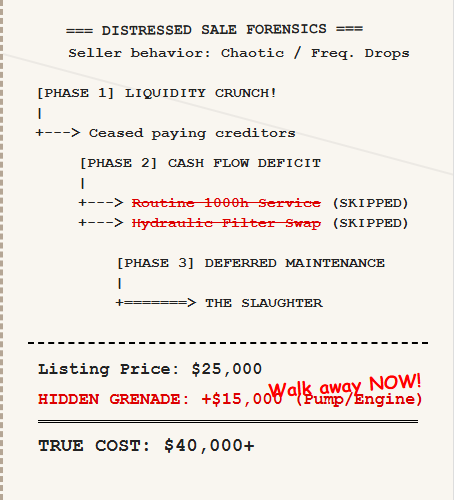
Dealing with the weasel words is the most difficult part, as you attempt to distinguish between a distressed sale and a regular fleet deal/change. They may have the same number of hours and price. An example of this is a contractor who, one month, puts a piece of equipment into service, and then another, perhaps with entirely different specifications some months later, and then another, perhaps completely different, six weeks later–this is a liquidity crunch. They’re liquidating as necessary, to meet cash flow deficits. It is also very likely that the machines were put up for sale under financial pressure and therefore were likely to have deferred maintenance from the operator’s decision to cease paying creditors the installments that they are owed.
Data sources for the table above:https://www.ironplanet.com/Mini+Excavator+%3C6.6t
Scenario A: Cat 302.7D CR 2400 hours, Rental Company in Germany, mid tier price positioning (right in the 50 percentile price position with hours for a given year), condition tag of ‘Good’. There are pictures of the underside revealing average roller wear and pitting-free cylinder rods. The machine was described as having been called upon mainly for making utility trenches in the Frankfurt metro area.
This is the kind of machine that I would purchase. Why: the 2,400 hours are approximately 3 years and 800 hours per year is about the time suggested for a commercial rental rotation. It’s been a machine which hasn’t been idle. The “Good” condition qualifies it as a realistic description by the seller; otherwise, the word “good” wouldn’t have been used. The trenching in a mostly built-up area is pretty low-violence territory—all the digging is pretty much in backfill, compacted soils and bituminous mix, and perhaps some clay… 0 hammering, no high flow attachment for a long period of time. Stress in hydraulic system is moderate. The amount of wear on the undercarriage is related to both hours and application.